
What You Need to Know Right Now
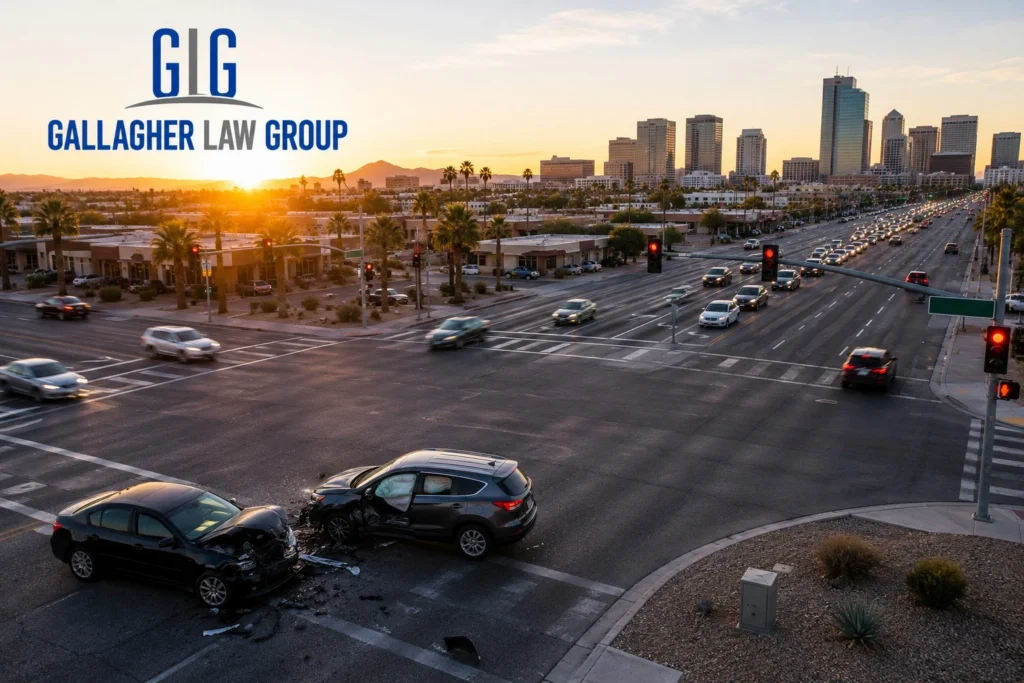
Phoenix has some of the most dangerous intersections in Arizona. High traffic volume, extreme heat, distracted drivers, and fast-moving arterials create serious crash risks throughout the city. The intersections with the highest collision rates are concentrated along major corridors, including Camelback Road, Indian School Road, and the I-10-Loop 101 interchange zones.
If you were injured at one of these locations, Arizona law gives you the right to pursue compensation from the at-fault driver or other responsible parties. The legal process involves proving fault, documenting your injuries, and negotiating with insurance carriers who work to minimize what they pay. An experienced car accident attorney can handle that process on your behalf while you focus on recovery.
About GLG Personal Injury Lawyers
GLG Personal Injury Lawyers is a Phoenix-based personal injury firm focused exclusively on helping injured individuals and families. Our attorneys have handled hundreds of car accident cases across Maricopa County.
We represent clients on a contingency fee basis, which means you pay nothing unless we recover compensation for you. Our firm is built on direct communication, honest case assessments, and results-driven representation. We do not accept every case. When we take yours, we are fully committed to it.
Why Phoenix Intersections Are So Dangerous
Phoenix is one of the fastest-growing cities in the country. With that growth comes more vehicles, more construction zones, and more pressure on a road network that was not designed for current traffic levels.
Several factors make Phoenix intersections uniquely hazardous. First, the city’s grid-based layout creates dozens of high-speed crossings where 45- to 55-mph arterials meet without adequate warning or signal timing. Second, extreme summer heat degrades road surfaces, fades lane markings, and contributes to driver fatigue. Third, the metro area has a high rate of uninsured motorists, which complicates claims when crashes occur.
Arizona also operates under a pure comparative fault system. That means even if you were partially at fault for a collision, you may still be entitled to recover damages. The amount is reduced by your percentage of fault, but it is not eliminated. This matters at complex intersections where multiple parties share responsibility.
The Most Dangerous Intersections in Phoenix, AZ
The following locations have been identified through crash data, traffic engineering reports, and local news coverage as areas with consistently high collision rates. These are not hypothetical risk zones. They are places where serious accidents happen regularly.
Camelback Road and 19th Avenue
This intersection sits in a dense commercial corridor with heavy pedestrian activity, frequent left-turn conflicts, and limited sightlines due to adjacent signage and landscaping. Rear-end collisions and angle crashes are common here, particularly during evening rush hours.
Indian School Road and 32nd Street
The combination of high-speed through traffic and frequent driveway access points along this stretch creates unpredictable merging patterns. Drivers entering from side streets often misjudge the speed of oncoming vehicles. T-bone collisions at this location have resulted in serious injuries.
Van Buren Street and 24th Street
This area carries significant commercial truck traffic alongside commuter vehicles. The width of Van Buren creates a false sense of safety for drivers making left turns. Pedestrian fatalities have been documented near this intersection, and visibility is reduced after dark.
I-10 and the Loop 101 Interchange
Freeway-to-freeway interchanges carry their own category of risk. Lane merges at high speed, distracted driving, and aggressive lane changes make this one of the most hazardous zones in the entire metro area. Crashes here frequently involve multiple vehicles and result in serious or fatal injuries.
Peoria Avenue and 75th Avenue
Located in a rapidly developing area of West Phoenix, this intersection has seen a significant increase in crash frequency as surrounding neighborhoods have grown. Signal timing has not kept pace with traffic volume, and left-turn movements are particularly dangerous during peak hours.
Thomas Road and 40th Street
Thomas Road is one of the most heavily traveled east-west corridors in central Phoenix. At 40th Street, the intersection handles a mix of residential, commercial, and commuter traffic. Side-impact crashes and rollover accidents have been reported at this location with enough frequency to warrant attention.
Crash Data at a Glance: Phoenix Intersection Risk Factors
The table below summarizes the key risk factors at Phoenix’s most dangerous intersections and their effects on crash outcomes.
| Risk Factor | Common Crash Type | Typical Injuries |
| High-speed arterial crossings | Angle / T-bone | Broken bones, head trauma |
| Left-turn conflicts | Head-on / sideswipe | Spinal injuries, lacerations |
| Pedestrian exposure zones | Pedestrian knockdown | Severe / fatal injuries |
| Freeway interchange merges | Multi-vehicle pileups | Traumatic brain injury, fatalities |
| Poor lighting or faded markings | Rear-end collisions | Whiplash, soft tissue damage |
| Construction zone proximity | Sideswipe / fixed object | Variable, often underestimated |
What Happens Immediately After a Crash at a Phoenix Intersection
The steps you take in the first hour after a collision have a direct impact on your ability to recover compensation. Arizona law requires drivers involved in accidents to stop, exchange information, and report collisions that result in injury or death.
Here is what our attorneys recommend:
- Call 911 and request medical assistance even if you believe your injuries are minor. Some injuries, including concussions and internal bleeding, do not present immediate symptoms.
- Do not admit fault or discuss how the crash happened with the other driver. Keep the conversation limited to exchanging contact and insurance information.
- Document the scene. Photograph vehicle positions, road conditions, traffic signals, skid marks, and any visible injuries.
- Obtain the names and contact information of any witnesses who saw the crash.
- Seek medical evaluation before leaving the area or as soon as possible afterward. A delay in treatment is often used by insurance companies to argue that your injuries were not serious or were caused by something else.
How Fault Is Determined at a Complex Intersection
Establishing fault at an intersection is not always straightforward. Multiple parties can share responsibility. The at-fault driver may dispute what happened. Insurance companies conduct their own investigations, and their findings are not always accurate.
Our attorneys work with accident reconstruction experts, traffic engineers, and medical professionals to build cases grounded in evidence. We obtain surveillance footage from nearby businesses, pull traffic camera data when available, and review the responding officer’s crash report for inconsistencies.
Arizona follows a pure comparative fault standard under A.R.S. Section 12-2505. Under this rule, a court assigns a percentage of fault to each party involved. Even if you were found 30 percent at fault, you can still recover 70 percent of your total damages. Insurance adjusters are aware of this rule and will use it to argue that you share more blame than you actually do. That is one reason why legal representation matters.
Common Injuries From Phoenix Intersection Crashes
Intersection crashes, especially high-speed angle collisions and T-bones, produce some of the most serious injuries seen in personal injury law. The force of impact in a side collision is absorbed directly by the occupant without the buffer of a crumple zone.
Injuries our firm has seen in intersection crash cases include:
- Traumatic brain injuries and concussions
- Cervical and lumbar spinal injuries, including herniated discs
- Broken ribs, arms, and leg fractures
- Internal organ damage
- Facial fractures and dental injuries
- Soft tissue damage that becomes chronic without proper treatment
Many of these injuries require surgery, extended physical therapy, and time away from work. The financial impact can be significant. Compensation in a car accident case can include medical expenses, lost wages, future medical costs, and non-economic damages such as pain and suffering.
Speak With a Car Accident Attorney in Phoenix
If you or a family member was injured at one of these intersections or anywhere else in the Phoenix metro area, GLG Personal Injury Lawyers is available to evaluate your case at no cost. A Phoenix, AZ car accident lawyer at our firm will review the facts, explain your options, and tell you directly whether you have a viable claim.
We also handle cases involving commercial vehicles, rideshare accidents, and collisions caused by road hazards or defective traffic controls. Our car accident attorney Phoenix clients have trusted us to handle cases ranging from minor intersection crashes to multi-vehicle freeway collisions with catastrophic injuries.
You do not need to navigate the insurance process alone. Our attorneys are here to handle it.
Frequently Asked Questions
How long do I have to file a car accident lawsuit in Arizona?
Arizona gives most car accident victims two years from the date of the crash to file a personal injury lawsuit. This deadline is set by the statute of limitations under A.R.S. Section 12-542. If you miss it, you lose the right to seek compensation through the courts. Acting quickly allows your attorney to gather evidence while it is still available and preserve witness accounts before memories fade.
What if the other driver ran a red light but there were no witnesses?
Cases without witnesses are more difficult but not impossible. Traffic camera footage, nearby business surveillance, the location of vehicle damage, skid mark analysis, and the responding officer’s report can all help establish that the other driver violated a traffic signal. Our attorneys know how to obtain this evidence and use it to build a strong case.
Can I still recover compensation if I was partially at fault for the crash?
Yes. Arizona uses a pure comparative fault system. If you were 20 percent at fault and the other driver was 80 percent at fault, you can still recover 80 percent of your total damages. Insurance companies often exaggerate the victim’s share of fault to reduce payouts. An attorney can push back on those assessments with evidence.
What is my case worth after a Phoenix intersection accident?
There is no formula that applies to every case. The value depends on the severity of your injuries, your medical costs, your lost income, the impact on your daily life, and the insurance coverage available. Our firm evaluates these factors during a free consultation and gives you a straightforward assessment. We do not inflate expectations or make promises we cannot keep.
Do I have to pay anything up front to hire your firm?
No. GLG Personal Injury Lawyers works on a contingency fee basis. You pay no attorney fees unless we recover compensation for you. Initial consultations are free. There is no financial risk in reaching out to us to discuss your case.
What should I do if the insurance company contacts me before I speak with a lawyer?
You are not required to give a recorded statement to the other driver’s insurance company. Insurance adjusters are trained to ask questions in ways that can be used to reduce or deny your claim. It is in your best interest to speak with an attorney before responding to any insurer. If the other driver’s insurance has already contacted you, call our firm before saying anything further.