

By Brendan Gallagher, Phoenix personal injury attorney, GLG Personal Injury Lawyers.
Yes. In Arizona, you can still recover damages after a car accident even if you were not wearing a seat belt. The driver who caused the crash remains responsible. However, Arizona allows a “seat belt defense,” which means the insurer can ask a jury to reduce your compensation for injuries it proves a seat belt would have prevented or made less severe. That reduction applies only to part of a claim, and the defense has to prove it.
Adjusters often bring up the seat belt question early, sometimes in the very first phone call, and sometimes in a way that suggests the injured person has no case. That is not how Arizona law works. If you were hurt in a crash in Phoenix or anywhere in the Valley while unbuckled, here is what the law actually says, how insurers use it, and how a Phoenix car accident lawyer pushes back.
What Arizona’s Seat Belt Law Requires
Arizona’s seat belt law is A.R.S. 28-909. It requires the driver and every front-seat passenger to wear a properly adjusted and fastened seat belt while the vehicle is moving. Passengers under 16 must be restrained no matter where they sit. This statute does not require adults 16 and older in the back seat to buckle up, although doing so is still the safest choice.
Occupant | Seat Belt Required by A.R.S. 28-909? |
Driver | Yes |
Front-seat passenger of any age | Yes |
Passenger under 16 in any seat | Yes, with child restraint rules for young children |
Back-seat passenger 16 or older | No |
For adults, a seat belt violation is a secondary offense, which means an officer generally needs another reason to pull a vehicle over before citing it. The fine is small. The bigger consequence usually shows up later, in the injury claim. Parents with questions about younger children can find more in our guide to when a child can sit in the front seat.
How the Seat Belt Defense Works in Arizona
Arizona’s seat belt defense comes from Law v. Superior Court, a 1988 Arizona Supreme Court decision. The court held that an injured person’s unreasonable failure to use an available seat belt can count as “fault” under Arizona’s comparative fault system. A jury may then reduce damages for injuries caused or worsened because the person was not buckled.
Three points from that framework matter most for injured people:
- Nonuse does not cause the crash. The defense does not shift blame for the collision itself. The at-fault driver who ran the light or rear-ended you is still responsible for causing it.
- The defense carries the burden. The insurer has to prove, usually with expert testimony, that a seat belt would have prevented or reduced specific injuries.
- Only enhanced injuries are affected. Injuries that would have happened even with a belt, such as a leg crushed by intrusion into the cabin, are not reduced.
Arizona follows pure comparative fault under A.R.S. 12-2505. Even when a jury assigns some fault for not wearing a seat belt, the injured person still recovers the rest. No cutoff eliminates a claim because of a high percentage of fault.
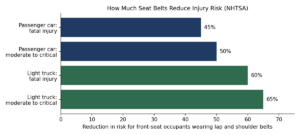
Source: National Highway Traffic Safety Administration. These figures explain why insurers raise the defense. They do not prove that a belt would have changed the injuries in any particular crash.
Which Damages Can Be Reduced
This is where the seat belt defense is often overstated. It does not apply a percentage cut to your whole case. It targets only the injuries the defense can tie to not wearing a belt. Consider a simplified example:
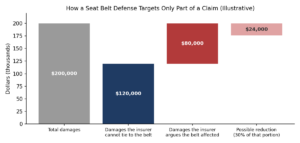
The numbers above are hypothetical. In this example, a jury finds that $80,000 of the injuries were made worse by not wearing a belt and assigns 30 percent fault for that portion. The reduction is $24,000, not 30 percent of the entire $200,000 claim.
In real cases, the dividing line between “would have happened anyway” and “made worse by not buckling” is often the main battle. Injuries from side impacts, rollovers with roof crush, and severe frontal crashes may have occurred regardless of belt use. Head and face injuries from striking the windshield or steering wheel are where insurers usually focus.
How Insurers Try to Prove You Were Unbuckled
Insurance companies do not simply take the adjuster’s word for it. They build the argument with evidence such as:
- The police crash report, which often includes a restraint code. Learn how to get a police report for your own crash.
- Event data recorder downloads, which in many vehicles record whether the driver’s belt was latched
- Emergency room records and paramedic notes describing restraint use
- The presence or absence of seat belt bruising across the chest or abdomen
- Statements you made at the scene or to an adjuster
Each of these can be wrong or incomplete. Police restraint codes are sometimes filled in from assumptions, and medical notes can be inaccurate. That is one reason not to discuss belt use with the other driver’s insurer before talking with a lawyer.
Brendan Gallagher on the Seat Belt Defense
“When an adjuster tells someone their case is worthless because they were not buckled, that is a negotiating tactic, not the law. In Arizona, the insurance company has to prove which injuries a seat belt would have prevented, and that takes real evidence, usually an expert. Many of the injuries we see in serious crashes would have happened either way. We make the insurer do the work instead of letting them use the seat belt question to scare people into a low offer.” Brendan Gallagher, GLG Personal Injury Lawyers
Told you have no case because you were not wearing a seat belt? Do not accept that from the insurance company. “When no others would take my case, GLG Personal Injury Lawyers extended their services.” Danny Nunez. Call (602) 922-7642 or contact us for a free consultation.
Passengers, Rideshares, and the Back Seat
Passengers face the seat belt question too. A front-seat passenger must buckle up, so the defense can be raised against them. An adult in the back seat is not required by A.R.S. 28-909 to wear a belt, which can make it harder for the insurer to argue that not buckling was unreasonable. This comes up often in rideshare accidents and passenger injury cases, where riders in the back seat may not buckle for a short trip.
Passengers also have an advantage drivers sometimes do not: they rarely share fault for causing the crash, and they may have claims against more than one driver. If a crash involved several vehicles, our guide to multi-car pile-ups explains how fault is divided.
Steps to Protect Your Claim
- Get medical care right away and follow through with treatment, even if you feel the injuries are minor. Our car accident checklist covers the first days after a crash.
- Do not give a recorded statement to the other driver’s insurer about seat belt use or anything else
- Preserve the vehicle until your attorney can arrange an inspection and data download
- Keep photos of the scene, the interior of the vehicle, and any visible injuries
- Track your medical bills, lost wages, and how the injuries affect daily life
Arizona generally gives injured people two years from the date of the crash to file a lawsuit. Waiting can let key evidence, like vehicle data, disappear. If someone was killed, a wrongful death claim follows its own rules, and the seat belt question can arise there too.
Frequently Asked Questions
Can I still sue if I was not wearing a seat belt in Arizona?
Yes. Not wearing a seat belt does not bar a personal injury claim in Arizona. The at-fault driver is still responsible for causing the crash, though the insurer may try to reduce damages for injuries it can prove the seat belt would have prevented or lessened.
What is the seat belt defense in Arizona?
The seat belt defense comes from Law v. Superior Court, a 1988 Arizona Supreme Court decision. It allows a jury to consider an injured person’s failure to wear an available seat belt as comparative fault, but only for injuries the defense proves were caused or made worse by not wearing it.
Who has to wear a seat belt in Arizona?
Under A.R.S. 28-909, the driver and every front-seat passenger must wear a seat belt, and passengers under 16 must be restrained in any seat. That statute does not require adults 16 and older riding in the back seat to buckle up.
Can a police officer pull me over for not wearing a seat belt in Arizona?
Not for an adult violation alone. Arizona treats the adult seat belt requirement as a secondary offense, so an officer generally needs another reason to stop the vehicle first.
Does not wearing a seat belt reduce all of my damages?
No. Any reduction applies only to the portion of your injuries the defense proves a seat belt would have prevented or reduced. The seat belt argument does not reduce damages for injuries that would have happened anyway, along with property damage.
How does the insurance company prove I was not wearing a seat belt?
Insurers look at police reports, vehicle event data recorders, medical records, witness statements, and the injury pattern itself. They often hire a biomechanical expert, and you can challenge that evidence.
Common Concerns After an Unbelted Crash
“I was not wearing a seat belt, so I should not even bother.” Arizona law does not take away your claim. At most, a jury may reduce part of your damages if the defense proves its case.
“The insurance company already said the seat belt is a problem.” Insurers raise this early because it lowers expectations. What matters is what the evidence shows about your specific injuries.
“I cannot afford a lawyer for a case like this.” GLG works on contingency. You pay no attorney fees unless we recover compensation for you.
What Happens When You Call
When you call GLG Personal Injury Lawyers at (602) 922-7642, our team will ask how the crash happened, where you were seated, what injuries you have, and what the insurance company has told you so far. If you have a police report or photos, we will ask you to share them. The consultation is free, and you will leave knowing whether the seat belt issue is likely to affect your case and what to do next to protect it. You can also meet Attorney Gallagher and read client testimonials before you call.
Talk to a Phoenix Car Accident Lawyer
Not wearing a seat belt does not mean you lose the right to be compensated by the driver who caused your crash. GLG Personal Injury Lawyers represents injured people across Arizona, including Mesa, Scottsdale, Chandler, and Glendale. “This firm is the best. Thank you GLG Personal Injury Lawyers.” Daryl Hodge. Call (602) 922-7642 or request a free consultation. You pay nothing unless we win.