

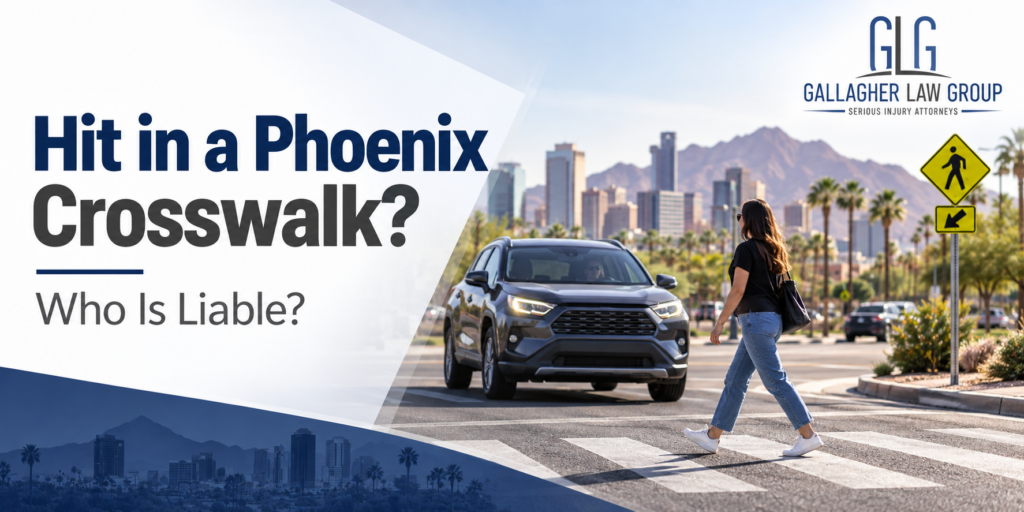
Arizona has one of the highest pedestrian fatality rates in the country, and the Phoenix metro area accounts for a substantial share of it.
The reasons are structural. Wide multi-lane arterials, high posted speeds, long distances between signalized crossings, and years of development built around driving rather than walking all contribute. So does the heat, which pushes pedestrian activity into darkness.
Drivers Must Yield in Crosswalks
Arizona requires drivers to yield the right of way to pedestrians crossing within a crosswalk, and the definition of a crosswalk is broader than most people assume.
A crosswalk exists at an intersection whether or not it is painted. The unmarked continuation of a sidewalk across an intersecting roadway is a crosswalk, and drivers must yield there just as at a marked one.
This is the single most misunderstood point in these cases. Drivers, and frequently adjusters, assume that no paint means no crosswalk. That is not the law.
Drivers are also prohibited from overtaking a vehicle stopped at a crosswalk to allow a pedestrian to cross, which addresses the multiple-threat scenario where a pedestrian steps out from in front of a stopped vehicle into an adjacent lane.
Pedestrian Duties
Pedestrians have obligations too, and the defense will invoke each one.
Crossing outside a crosswalk between adjacent signalized intersections generally requires yielding to vehicles. Crossing against a signal is prohibited. Suddenly leaving a curb into the path of a vehicle so close that it constitutes an immediate hazard is prohibited.
Violating these supports a comparative fault argument. In Arizona, that reduces recovery proportionally rather than eliminating it, which is a substantially better position than a pedestrian would face in many other states.
The Jaywalking Argument Is Not the End
Insurers often reach for jaywalking, and they frequently overstate it.
Even when a pedestrian crosses outside a crosswalk, drivers still have a duty to use due care to avoid colliding with any pedestrian, sound a horn when necessary, and use proper precautions when observing a child or an obviously confused or incapacitated person.
A driver who was speeding, distracted, impaired, or simply not paying attention remains responsible even when the pedestrian was not in a crosswalk. The percentages shift, and the claim survives.
Because Arizona is a pure comparative fault state, a pedestrian found substantially at fault still recovers a reduced amount. A claim that would be worthless in a contributory negligence state remains viable here.
What Determines Fault
- Where the impact occurred relative to the crosswalk and the curb
- The vehicle’s speed, established through damage patterns and event data
- Signal timing and phase at the moment of the collision
- Lighting conditions and whether the area was adequately lit
- Sight line obstructions from parked vehicles, landscaping, or signage
- Whether the driver was distracted, established through phone records
- Camera footage from businesses, residences, and traffic systems
Signal timing data is available and is frequently decisive. Where a pedestrian had a walk phase, the analysis is straightforward. Where the phase had changed, the question becomes how long the pedestrian had been in the roadway and whether the driver should have seen them.
Lighting, Design and Government Responsibility
Where a crossing was inadequately lit, poorly designed, or lacked appropriate controls, responsibility may extend beyond the driver to the entity responsible for the roadway.
Phoenix arterials frequently place signalized crossings far apart, producing predictable mid-block crossing behavior. Where an entity knew of a persistent crossing pattern and did nothing, that history becomes relevant.
Claims against governmental entities carry a short notice requirement measured in months, and missing it bars the claim regardless of merit. If a road defect, signal malfunction, or lighting failure contributed, identifying the responsible entity early is essential.
Speed Determines Survival
The relationship between impact speed and pedestrian outcome is steep and well established. Survival rates fall dramatically as speed rises, and Phoenix arterials carry posted limits at the upper end of that curve.
This matters legally as well as medically. Establishing actual speed rather than accepting the driver’s account is central to how GLG handles these cases, and event data recorders, damage analysis, and throw-distance calculations all contribute.
When a driver was exceeding the speed limit, the argument shifted substantially, even when the pedestrian was outside a crosswalk.
Parking Lots and Backing Collisions
Not every pedestrian collision happens on a roadway. A substantial share occur in parking lots, at drive-through entrances and in commercial access areas.
Rear-end collisions are a recurring pattern, and they disproportionately involve children and older adults who fall below a driver’s line of sight behind a vehicle.
Fault in these cases turns on the driver’s duty to ensure the maneuver could be made safely, the availability and use of backup cameras and sensors, and the design of the lot itself.
Where a property owner created a hazardous circulation pattern or failed to provide pedestrian routes, responsibility may extend to them as well as to the driver.
Injuries Are Severe
A pedestrian has no protection whatsoever, and the injury pattern reflects that — lower extremity fractures from the initial impact, torso and head injuries from contact with the vehicle, and further head injuries on striking the ground.
Traumatic brain injuries are common and are frequently underestimated at the scene. Symptoms can appear hours or days later, and a gap between the crash and evaluation is often used to argue something else caused them.
Because the injuries are severe, the damages analysis is more involved. Life care planning, vocational assessment, and economic analysis are frequently necessary to establish lifetime costs, and settling before the medical picture is clear is a costly mistake.
Available insurance is also often inadequate, which makes the injured person’s own uninsured and underinsured coverage important. A pedestrian can make a claim under their own auto policy even if none of their cars were involved.
Children and Older Pedestrians
Two groups appear disproportionately in these cases and are treated differently.
Children are not held to the same standard of care as adults. A young child who ran into the roadway is evaluated based on what a child of that age and experience would reasonably do, and Arizona law specifically requires drivers to exercise proper precaution when observing a child.
Older pedestrians move more slowly and may not clear a crossing within a signal phase timed for average walking speed. A driver who accelerates on a change of phase into a pedestrian still lawfully in the crosswalk bears responsibility.
Both groups also sustain more severe injuries at any given impact speed, which substantially affects the damage analysis.
Hit-and-Run Pedestrian Cases
A significant proportion of pedestrian fatalities involve drivers who leave the scene, and Phoenix is no exception.
When the driver is never identified, the injured person’s own uninsured motorist coverage becomes the source of recovery, even if none of their vehicles were involved.
Prompt reporting and camera canvassing matter a great deal. Residential doorbell systems, business cameras, and traffic systems frequently capture footage of a fleeing vehicle, and that footage is overwritten within days unless someone requests it.
What to Do
- Call the police and ask them to generate a report.
- Photograph the scene, including the crosswalk, signals, lighting,g and sight lines.
- Note the exact location of impact relative to the curb and any markings.
- Get contact details for witnesses before they leave.
- Look for cameras on nearby businesses and residences.
- Seek medical attention immediately, particularly for any head impact.
- Do not give a recorded statement to the driver’s insurer before getting advice.
Deadlines apply here as elsewhere. Arizona generally allows two years from the date of injury, and far less where a governmental entity may be responsible for lighting, signal timing, or roadway design. Establishing early who was responsible for the crossing itself can matter as much as identifying the driver.
If you or a family member was struck by a vehicle in Phoenix, call GLG. Arizona’s fault rules are more favorable than most people assume, and a jaywalking accusation is not the end of the claim.