

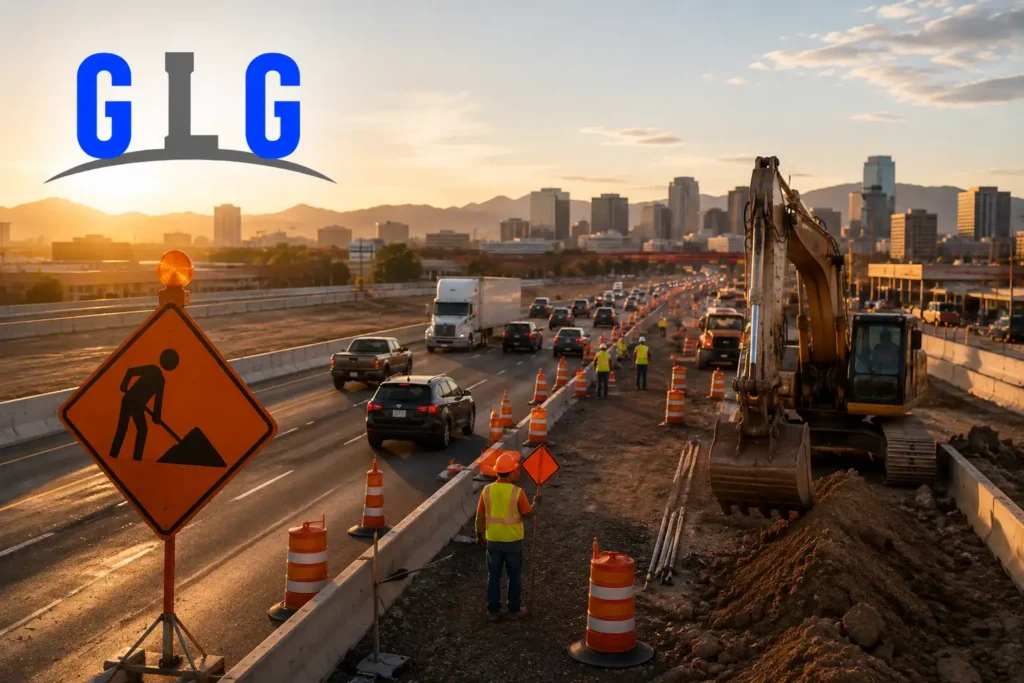
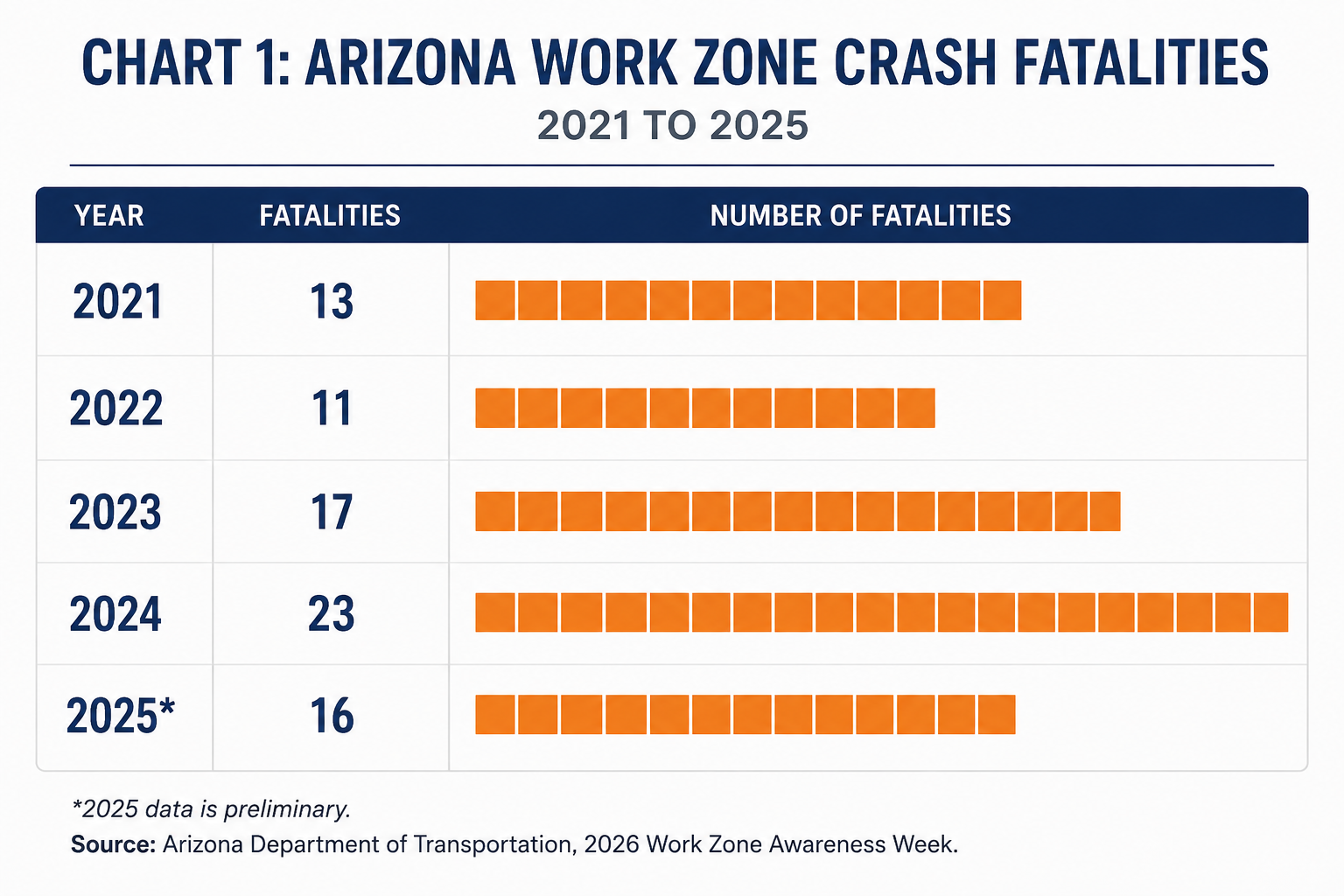
Arizona work zones are a serious traffic safety issue. ADOT reports that at least 80 people were killed in work zone-related crashes on Arizona roads from 2021 through 2025. Fatalities rose from 13 in 2021 to 23 in 2024 before preliminary 2025 data showed 16 deaths. These crashes can be more complicated than ordinary collisions because fault may involve another driver, a commercial contractor, or a public entity responsible for the roadway. If a government entity may be responsible, Arizona’s notice-of-claim law can require action within 180 days, much sooner than the ordinary two-year personal injury limitation period.
Arizona drivers are used to orange cones. In Phoenix, road construction is not a short seasonal inconvenience. Freeway widening, pavement work, utility projects, interchange improvements, and rapidly changing lane configurations are part of everyday travel across the Valley.
That makes work zone crashes worth looking at separately from ordinary Arizona car accidents. A rear-end collision in a construction zone may begin with a speeding or distracted driver, but the investigation can also raise questions about temporary lane markings, warning signs, barriers, lighting, traffic control plans, and the conduct of contractors working beside live traffic.
For injured drivers and passengers, those extra questions matter because they can change who is legally responsible, what evidence must be preserved and how quickly a claim must be pursued.
Arizona Work Zone Fatalities Have Remained Stubbornly High
ADOT’s 2026 Work Zone Awareness Week data provides a five-year snapshot. At least 80 people died in work zone-related crashes on all Arizona roads between 2021 and 2025. The 2025 numbers remain preliminary.
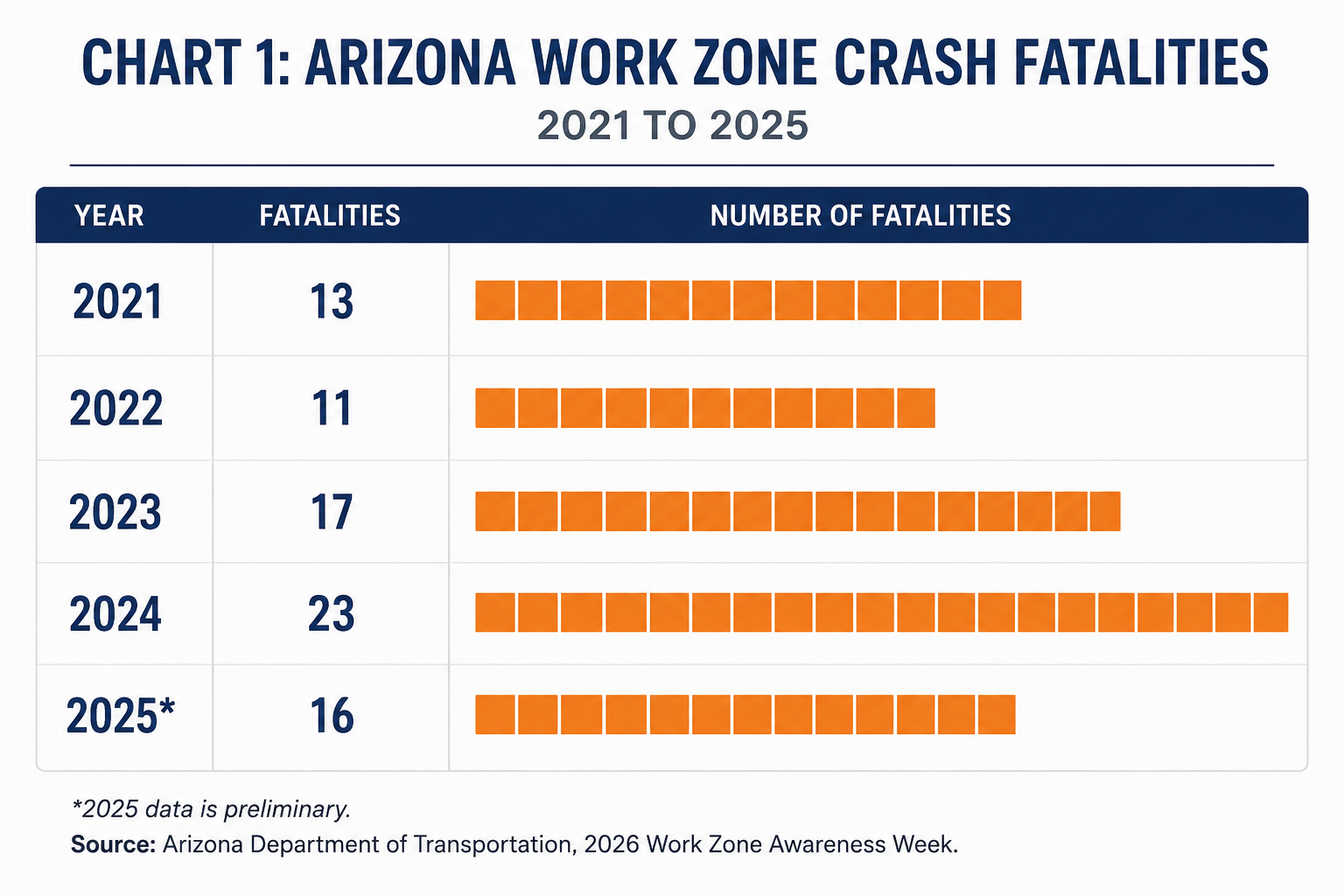
The 2024 total stands out. With 23 work zone deaths, it was more than double the 2022 total of 11. Preliminary 2025 data suggests fatalities fell, but serious injuries did not. ADOT reported 36 serious injuries in 2025, the highest figure in the five-year series.
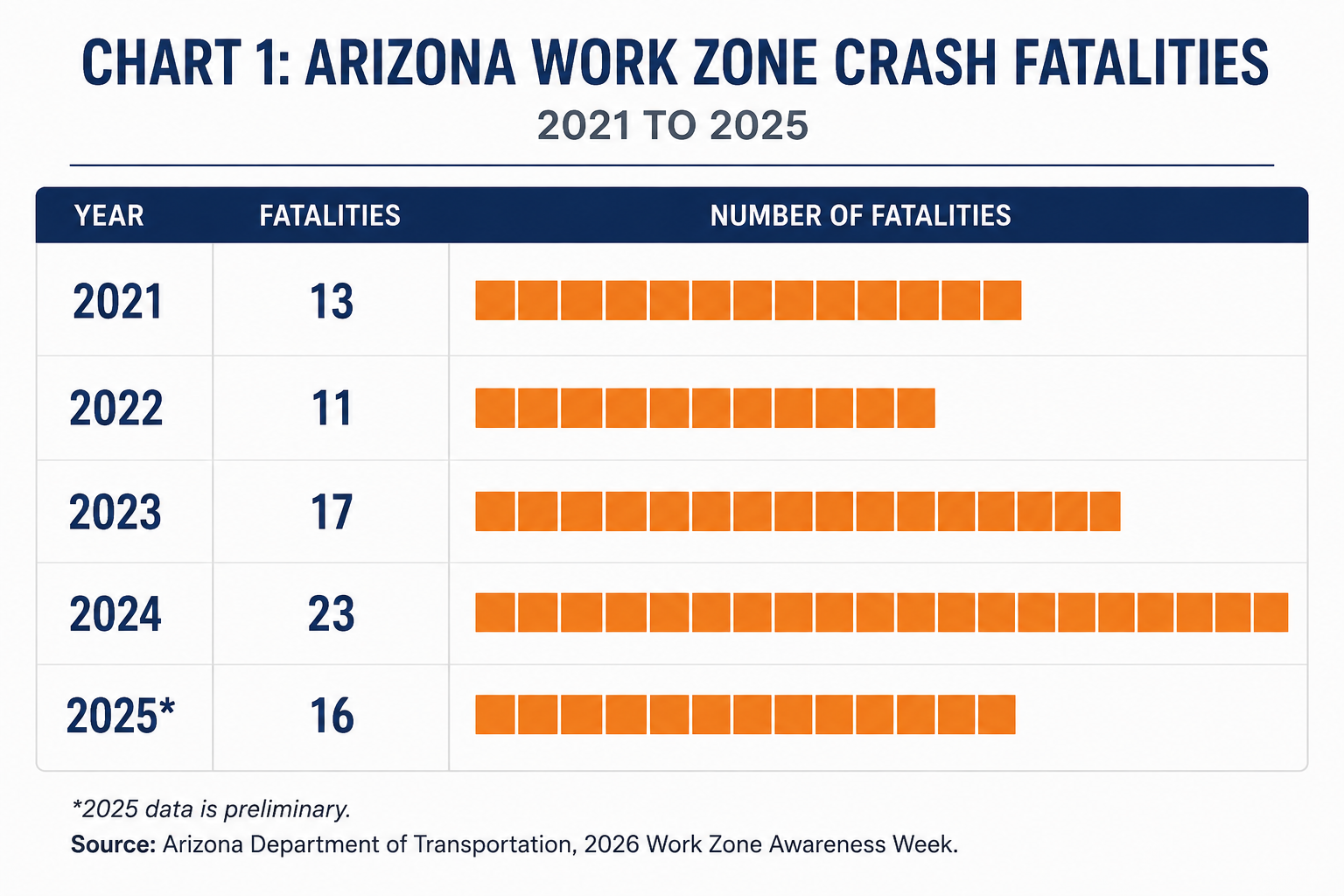
From 2021 to the preliminary 2025 period, reported serious injuries increased by about 38 percent, from 26 to 36. The trend is important because a work zone safety problem cannot be measured by deaths alone. Survivors may face traumatic brain injuries, fractures, spinal injuries, surgeries, rehabilitation, and months away from work.
Why Phoenix and Maricopa County Drivers Face Constant Work Zone Exposure
The Phoenix metropolitan area continues to experience major transportation construction as population and traffic demands grow. ADOT’s Central District planning has included projects on I-10, I-17, Loop 101, Loop 202, Loop 303, and SR 347, among other corridors.
One recent example is the I-10 Broadway Curve Improvement Project. The project covered roughly 11 miles of I-10 between the I-17 Split and Loop 202, affecting travel through Phoenix, Tempe, Chandler, and Guadalupe. Construction began in 2021, and major construction was completed in spring 2025, with final acceptance anticipated in 2026. ADOT reports an anticipated project cost of approximately $863.5 million.
Other major Valley projects have included Loop 101 widening in Scottsdale and the Loop 101 corridor from 75th Avenue to I-17. For Phoenix-area motorists, this means construction-related traffic patterns can appear on both freeway commutes and surface streets.
Phoenix itself is also using speed enforcement as part of its road safety strategy. During the 30-day warning phase of the city’s 2026 Photo Safety Program, nine corridor cameras recorded more than 70,000 events involving vehicles exceeding posted speed limits. Phoenix officials specifically identified speed as a common factor in severe and fatal collisions.
Work zones amplify that danger. A driver who is traveling too fast has less time to react when lanes narrow, traffic stops unexpectedly, or a temporary barrier changes the normal path of travel.
What Causes Work Zone Crashes?
ADOT warns that speeding is a major cause of work zone crashes and that rear-end collisions are the most common crash type in work zones. That combination makes sense. Construction frequently creates sudden backups in places where traffic normally moves at freeway speeds.
Common contributing factors include:
- Speeding or driving too fast for changing conditions
- Following too closely in stop-and-go traffic
- Distracted driving near lane shifts or flaggers
- Unsafe merging when a lane closes
- Confusing or missing temporary lane markings
- Inadequate warning signs or lighting
- Construction equipment entering or leaving active traffic
- Debris, uneven pavement or abrupt roadway transitions
- Drivers striking temporary barriers or attenuators
National work zone data also challenges a common assumption about who is most at risk. According to the Federal Highway Administration statistic cited by ADOT, nearly 80 percent of work zone fatalities nationwide are drivers and passengers, not roadway workers.
Who Can Be Liable for an Arizona Construction Zone Accident?
A work zone does not automatically make the construction company responsible. Liability depends on what caused the crash. In some cases, the only negligent party may be another driver. In others, several parties may have contributed.
Another driver may be responsible for speeding, distracted driving, following too closely, unsafe lane changes, or ignoring traffic control devices.
A contractor or subcontractor may become relevant when the evidence shows that traffic control, equipment placement, temporary markings, barriers, or other work-zone conditions were negligently created or maintained.
A public entity may also need to be investigated when the claim involves the design, maintenance, control, or oversight of a public roadway. Claims against government entities have special procedural rules, so identifying a potential public defendant early can be critical.
Arizona’s comparative negligence law also matters. Under A.R.S. § 12-2505, a claimant’s damages can be reduced in proportion to the claimant’s share of fault. A construction-zone case can therefore involve several competing arguments about how much responsibility belongs to each driver, contractor, or other party.
The 180-Day Deadline Can Change Everything
Most Arizona personal injury actions are subject to a two-year limitation period under A.R.S. § 12-542. That does not mean every injured person can safely wait two years.
If a claim is against an Arizona public entity or public employee, A.R.S. § 12-821.01 generally requires a notice of claim within 180 days after the cause of action accrues. The statute also requires specific information, including facts supporting liability and a specific amount for settlement. In addition, A.R.S. § 12-821 generally provides a one-year limitation period for actions against public entities or public employees.
These rules are one reason a construction-zone collision should not automatically be handled like a routine two-car insurance claim.
Evidence Can Disappear as the Work Zone Changes
Work zone evidence has a short shelf life. A normal intersection may look substantially the same weeks after a crash. A construction zone may not.
Cones move. Barriers are repositioned. Lane markings change. Signs disappear. Pavement is resurfaced. A traffic pattern that existed on Tuesday may be gone by Friday.
Important evidence can include photographs and video of the exact lane configuration, police crash reports, body-camera footage, 911 recordings, witness statements, dashcam video, vehicle event data, construction traffic-control plans, contractor records, inspection records, permits, and roadway-camera footage.
Phoenix Police allows public-record requests for traffic crash reports, body-camera audio and video, photographs, recorded interviews, surveillance video, 911 recordings, and other records. Serious traffic collisions and traffic fatalities within Phoenix may be investigated by the Phoenix Police Vehicular Crimes Unit, while interstate and freeway crashes can fall under the Arizona Department of Public Safety.
What Should You Do After a Phoenix Construction Zone Crash?
Get medical care first. Then, if you can do so safely, document more than vehicle damage. Photograph the road behind and ahead of the collision. Capture temporary speed signs, lane-closure signs, cones, barriers, construction equipment, lane markings, and any unusual pavement condition.
Save the exact location and direction of travel. A statement such as “I-10 near Phoenix” is far less useful than identifying the freeway, direction, nearest exit, lane, and construction configuration.
Do not assume the police report will contain every detail needed for a civil injury claim. Police investigators have different responsibilities from those of a personal injury legal team. Evidence about a contractor’s traffic-control plan, project records, or temporary roadway design may require separate investigation.
How GLG Personal Injury Lawyers Can Help After an Arizona Work Zone Crash
A serious work zone crash can involve more moving parts than the vehicles that collide. GLG Personal Injury Lawyers represents injured people in Phoenix and throughout Arizona and can investigate how the collision happened, identify potentially responsible parties, preserve evidence, and deal with insurers while the client focuses on recovery.
For a work zone claim, early investigation can be especially important because the physical scene may change and government-related deadlines may apply. If you were injured in a Phoenix-area construction zone, a legal review can help determine whether the case is a straightforward driver-negligence claim or whether contractors, public entities, or other parties should also be investigated.
Frequently Asked Questions
How many people have died in Arizona work zone crashes recently?
ADOT reports at least 80 work zone-related fatalities from 2021 through preliminary 2025 data. Annual fatalities were 13 in 2021, 11 in 2022, 17 in 2023, 23 in 2024, and 16 in preliminary 2025 data.
Are construction workers the people most often killed in work zone crashes?
No. ADOT cites federal data showing that nearly 80 percent of work zone fatalities nationwide are drivers and their passengers.
Who is responsible for a Phoenix construction zone accident?
Responsibility depends on the cause. A negligent driver may be liable, but a contractor, subcontractor, or public entity may also need to be investigated when traffic control, roadway conditions, or project oversight contributed to the crash.
How long do I have to file an Arizona work zone injury claim?
Many private-party Arizona personal injury claims have a two-year limitation period, but claims against public entities can involve a 180-day notice requirement and a one-year limitation period. The correct deadline depends on the parties and facts involved.
Why should work zone evidence be preserved quickly?
Construction zones change constantly. Temporary signs, cones, barriers, lane markings, and traffic patterns may be moved or removed shortly after a collision, while video can be overwritten.