


Speed remains one of Arizona’s most serious roadway dangers. In 2024, 417 people were killed, and 20,722 were injured in crashes where “speed too fast for conditions” or “exceeded lawful speed” was marked on the crash report, according to the Arizona Department of Transportation. Speed-related crashes accounted for about 34% of all Arizona traffic deaths and 38% of all crash injuries that year. If a speeding driver caused your injuries, evidence of speed can be central to proving negligence and recovering compensation.
Key Takeaways
- 417 people were killed in Arizona speed-related crashes in 2024.
- 20,722 people were injured in speed-related crashes in 2024.
- Speed-related deaths represented about 34% of Arizona’s 1,228 traffic fatalities in 2024.
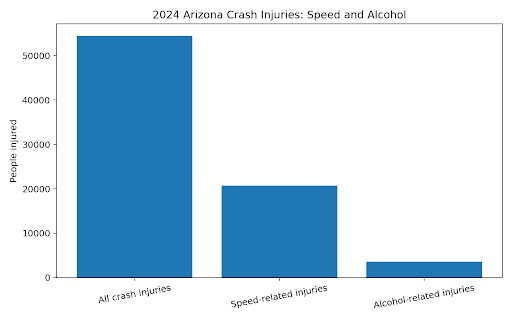
- Speed-related injuries represented about 38% of the state’s 54,426 crash injuries.
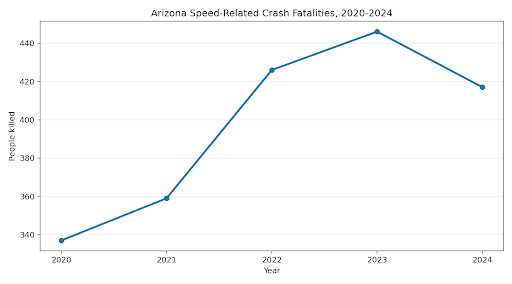
- Speed-related deaths rose from 337 in 2020 to 417 in 2024, a roughly 24% increase over five years, although fatalities declined from the 2023 peak of 446.
- Arizona law not only prohibits driving above a posted limit. A.R.S. § 28-701 also requires drivers to travel at a speed that is reasonable and prudent for existing conditions and hazards.
- Arizona follows pure comparative negligence. An injured person’s compensation can be reduced by the percentage of fault assigned to that person.
- Most Arizona personal injury lawsuits are subject to a two-year filing deadline under A.R.S. § 12-542, although shorter deadlines may apply in certain situations, including claims involving public entities.
Speeding is easy to treat as an ordinary traffic violation until the numbers are put beside Arizona’s overall crash toll. In 2024 alone, more than 20,000 people were injured in crashes in which speed was identified on the crash report. More than 400 people died. Those deaths were not a small fraction of the state’s roadway fatalities. They represented roughly one out of every three people killed in Arizona motor vehicle crashes.
For drivers and families in Phoenix, the problem is especially important. Phoenix’s Road Safety Action Plan identifies safe speeds as part of its Safe System approach, and the city’s 2024 annual update continues to track speed-related fatal and serious-injury crashes as a core safety measure. The city is also focusing safety resources on a High Injury Network comprising intersections and road segments with concentrated histories of fatal and serious-injury crashes.
For someone injured by a speeding driver, these statistics also have a practical legal meaning. Speed can affect whether a driver had enough time to react, whether the driver could safely control the vehicle, the violence of the impact, the severity of the injuries, and the evidence needed to establish fault.
GLG Personal Injury Lawyers handles serious motor vehicle claims throughout Phoenix and across Arizona, including cases involving speeding, highway crashes, motorcycle crashes, pedestrian crashes, and wrongful death.
Arizona Speed-Related Crash Statistics at a Glance
The most recent complete annual Arizona Motor Vehicle Crash Facts report is ADOT’s 2024 report. ADOT counted a crash as speed-related for this summary when the violation “speed too fast for conditions” or “exceeded lawful speed” was marked on the crash report.
- Total motor vehicle crashes | 121,107
- Total people killed | 1,228
- Total people injured | 54,426
- People killed in speed-related crashes | 417
- People injured in speed-related crashes | 20,722
- Speed-related dea
2024 Arizona Crash Statistics
ths as share of all crash deaths | About 34.0%
- Speed-related injuries as share of all crash injuries | About 38.1%
- People killed in alcohol-related crashes | 347
- People injured in alcohol-related crashes | 3,576
- Estimated statewide economic losses from all motor vehicle crashes | $20.890 billion
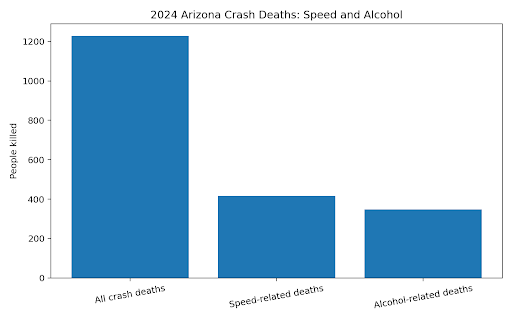
The comparison is striking. Speed was associated with more deaths in 2024 than alcohol-related crashes, based on the categories reported by ADOT. These categories can overlap, so they should not be added together or treated as mutually exclusive causes. A crash can involve both excessive speed and alcohol, for example.
Speed-Related Deaths in Arizona Remain Far Above 2020 Levels
Arizona’s five-year trend shows that the 2024 decline did not erase the broader problem.
Year | People Killed in Speed-Related Crashes
- 2020 | 337
- 2021 | 359
- 2022 | 426
- 2023 | 446
- 2024 | 417
From 2020 to 2024, speed-related deaths increased by approximately 23.7%. The state did make progress from 2023 to 2024, when the number fell from 446 to 417, a decrease of about 6.5%. Even after that improvement, however, Arizona recorded 80 more speed-related deaths in 2024 than it did in 2020.
That distinction matters. A one-year decline can be encouraging without meaning the underlying danger has disappeared. Arizona still experienced more than one speed-related death per day on average in 2024.
The trend also mirrors a national problem. The Insurance Institute for Highway Safety reports that around 11,000 people died in speed-related crashes nationwide in 2024, representing about 29% of all crash fatalities. Arizona’s roughly 34% share was higher than that national proportion.
Speed-Related Injuries Have Increased Even While Deaths Fell in 2024
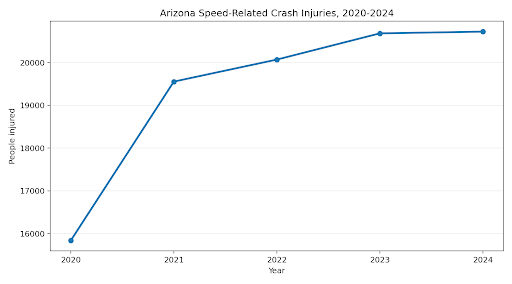
The injury trend tells a different story from the fatality trend.
Year | People Injured in Speed-Related Crashes
- 2020 | 15,839
- 2021 | 19,554
- 2022 | 20,069
- 2023 | 20,682
- 2024 | 20,722
Speed-related injuries increased every year in this five-year period. From 2020 to 2024, the number of injuries rose by 4,883, or about 30.8%. Even between 2023 and 2024, when speed-related deaths declined, reported speed-related injuries edged upward from 20,682 to 20,722.
This is one reason a speeding crash should not be judged solely by whether it resulted in a fatality or a visibly damaged vehicle. Tens of thousands of people survive these collisions and may face emergency treatment, surgery, rehabilitation, time away from work, chronic pain, or permanent impairment.
Why Does Speed Make a Crash So Much More Dangerous?
Speed affects both the likelihood of a collision and the outcomes when vehicles, pedestrians, motorcycles, or fixed objects are struck.
The Insurance Institute for Highway Safety explains that higher speeds increase the distance a vehicle travels while a driver perceives and reacts to a danger, increase the distance required to stop after braking begins, make loss of control more likely during evasive maneuvers, and increase crash energy disproportionately.
The physics are unforgiving. IIHS notes that increasing impact speed from 40 mph to 60 mph is a 50% increase in speed, but it produces a 125% increase in the energy that must be managed during the crash. Seat belts, airbags, vehicle structures, barriers, and other safety systems all have limits. Higher impact energy makes those limits easier to exceed.
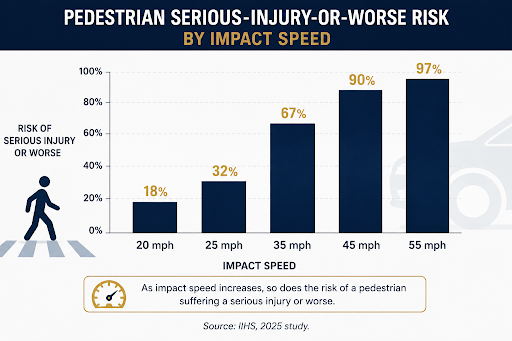
The danger is even greater for people outside a passenger vehicle. A 2025 IIHS study of U.S. pedestrian crashes found that the average risk of serious injury or worse was 18% at 20 mph, 32% at 25 mph, 67% at 35 mph, 90% at 45 mph, and 97% at 55 mph. Those national figures help explain why speed management matters so much on Phoenix streets, where drivers, pedestrians, bicyclists, and motorcyclists share the transportation system.
What Counts as Speeding Under Arizona Law?
A speeding claim is not limited to proving that another driver was traveling above the number printed on a roadside sign.
A.R.S. § 28-701 requires a driver to travel at a speed that is reasonable and prudent under the circumstances, conditions, and actual and potential hazards. The statute also requires a driver to control speed as necessary to avoid a collision while exercising reasonable care for others.
That means a driver can potentially be traveling too fast for conditions even when the speedometer is below the posted limit. Conditions that can require a lower speed include approaching an intersection or railroad crossing, navigating a curve or hillcrest, traveling on a narrow or winding road, encountering pedestrians or traffic, and dealing with weather or highway hazards.
Arizona also has a separate excessive-speed statute. Under A.R.S. § 28-701.02, certain excessive speeds can constitute a class 3 misdemeanor, including exceeding a posted speed limit by more than 20 mph in specified circumstances. The criminal or traffic consequences of speeding are separate from an injured person’s civil claim for compensation.
A driver also does not have to receive a speeding ticket for an injured person to pursue a negligence claim. A civil case can rely on the complete body of evidence surrounding the collision rather than the presence or absence of one citation.
Speed Compared With Other Major Arizona Crash Risks
ADOT’s 2024 report provides another useful way to understand the scale of the problem. Arizona recorded 1,228 total motor vehicle deaths. Of those, 417 occurred in speed-related crashes, and 347 occurred in alcohol-related crashes. Again, these categories may overlap, but the comparison shows that speed belongs in the top tier of Arizona roadway risks.
ADOT’s driver-violation data also show how common speed-related violations are in crash reports. In 2024, “speed too fast for conditions” was recorded for 32,466 drivers, while “exceeded lawful speed” was recorded for 733. By comparison, failure to yield right-of-way was recorded for 23,078 drivers, unsafe lane changes for 10,484, following too closely for 7,593, and disregarding a traffic signal for 5,891.
These figures are not the same thing as crash totals because they count driver violations, not individual crashes. They do, however, show how frequently speed appears in the behavioral data collected after Arizona collisions.
What the Phoenix Data Says About Speed and Serious Crashes
Phoenix is not treating speeding as an abstract statewide issue. The City of Phoenix adopted its Road Safety Action Plan in 2022 with a goal of eliminating fatal and serious-injury crashes by 2050. Safe speeds are one of the plan’s core Safe System elements.
The city’s 2024 annual update reported that fatal crashes remained 16% above the original 2016-2020 baseline average, even though fatal and serious-injury crashes as a combined category had declined. The city specifically identified higher speeds as one of several possible factors contributing to the elevated number of fatal crashes in the 2020s.
Phoenix also updated its High Injury Network using crash data from 2018 through 2022. That analysis reviewed 4,538 crashes involving a fatality or serious injury and identified 51 signalized intersections, 79 roadway segments, and five unsignalized intersections for the High Injury Network. The point of the network is to direct limited safety resources toward locations with concentrated histories of severe crashes.
The city has also moved toward targeted speed enforcement. Phoenix’s 2024 report states that the Police Department uses radar trailers followed by motor-officer enforcement in areas identified through complaints, officer awareness, and statistical data. Phoenix City Council approved an Automated Enforcement Safety Program in October 2024, with a focus on school-zone speed enforcement and high-collision locations. Phoenix also participates with West Valley agencies in a speed-enforcement task force that rotates among Phoenix, Peoria, Surprise, Tolleson, Glendale, Buckeye, Goodyear, and Avondale.
For people who drive regularly on I-10, I-17, Loop 101, Loop 202, SR 51, US 60, or high-volume Phoenix arterials, the local lesson is straightforward. Higher-speed environments leave less room for a mistake. GLG’s Phoenix highway car accident practice addresses many of the same evidence and injury issues that become important when speed turns an ordinary traffic conflict into a major collision.
How Is Speed Proven After an Arizona Car Accident?
A police report can be important, but serious speeding claims often require more than a box checked on the report. Evidence can disappear quickly, particularly digital data and video.
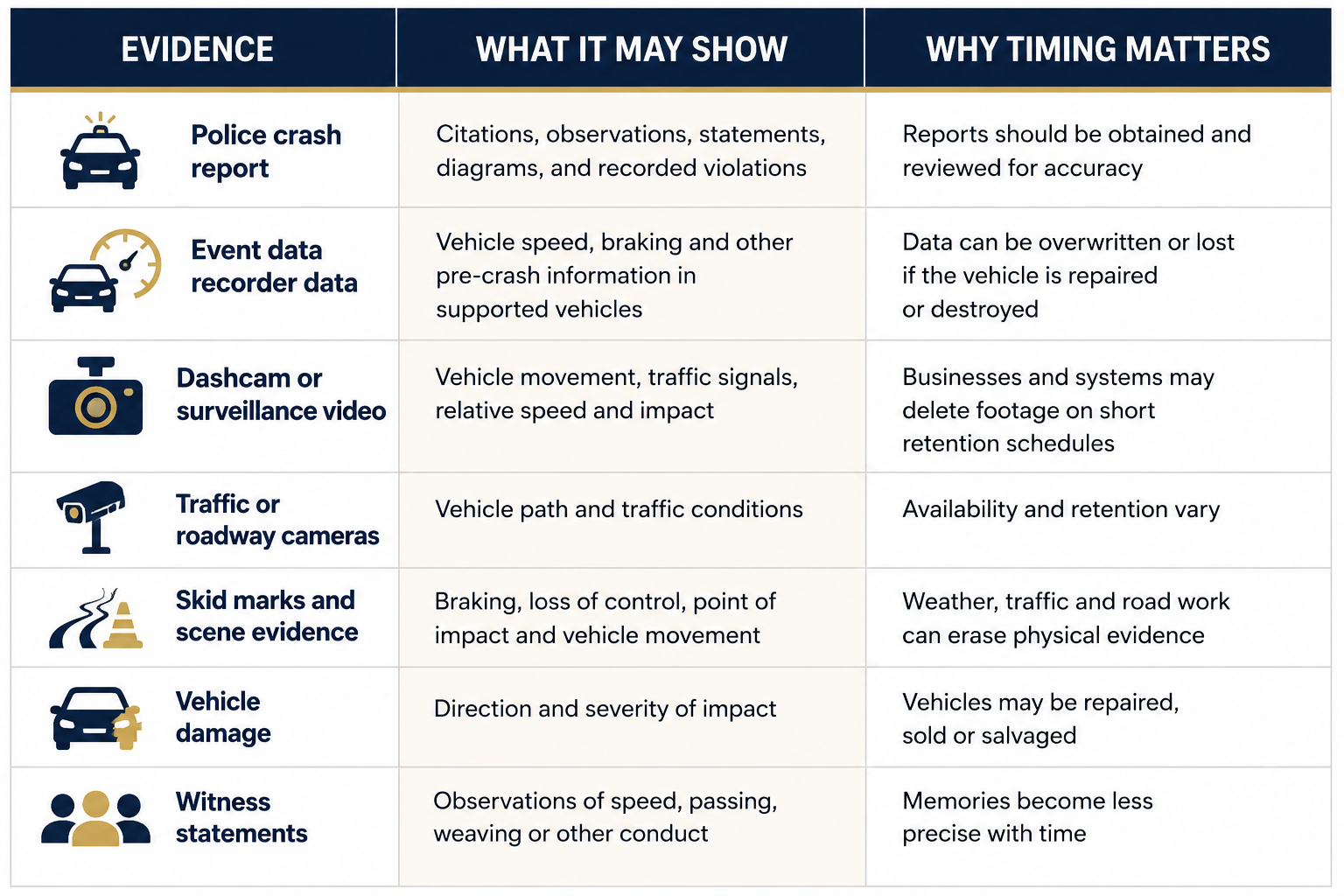
GLG’s Phoenix speeding car accident lawyer page explains why these cases can require crash reconstruction, scene analysis, data downloads, witness evidence, and medical documentation. The sooner that evidence is identified, the more options there may be for preserving it.
Can a Speeding Driver Be Negligent Even Without a Ticket?
Yes. A traffic citation and a civil personal injury claim are different matters. The central civil questions are whether the driver failed to use reasonable care, whether that failure caused the collision, and whether the collision caused compensable harm.
A citation may support an investigation, but the absence of a citation does not automatically establish that the driver was traveling safely. Investigators may use vehicle data, physical evidence, video, witness statements, and reconstruction to independently evaluate speed.
This is particularly important in “too fast for conditions” cases. A driver may insist, “I was under the speed limit,” while the evidence shows that the speed was unsafe for traffic congestion, a curve, an intersection, reduced visibility, a dust storm, standing water, construction, or another hazard. Arizona’s reasonable-and-prudent-speed law expressly recognizes that context matters.
What if Both Drivers Were Speeding or I Am Partly at Fault?
Arizona follows pure comparative negligence under A.R.S. § 12-2505. If an injured claimant is assigned a percentage of fault that contributed to the injury, the damages can be reduced by that percentage rather than automatically eliminated.
For example, assume a jury determines that total damages are $200,000 and assigns 20% of the fault to the injured driver. A 20% reduction would leave $160,000. That is a simplified illustration, not a prediction of what any particular case is worth.
Comparative fault makes evidence especially important. Insurance companies may argue that an injured driver was also speeding, changed lanes unsafely, followed too closely, failed to react, or otherwise contributed to the collision. Preserving objective evidence can help test those allegations rather than allowing the claim to devolve into competing stories.
What Compensation May Be Available After a Speeding Crash?
A person injured because of another driver’s negligence may be able to seek compensation for losses caused by the collision. The available categories depend on the facts and injuries, but they can include medical expenses, future medical care, lost wages, reduced future earning capacity, property damage, pain and suffering, disability, disfigurement, and loss of enjoyment of life.
High-speed crashes can create unusually large future losses when they cause traumatic brain injuries, spinal injuries, orthopedic trauma, internal injuries, or permanent impairment. A settlement that pays today’s bills but ignores future treatment or diminished earning ability can leave an injured person carrying costs long after the claim is closed.
When speeding results in a death, eligible family members may have rights under Arizona’s wrongful death laws. GLG’s Phoenix wrongful death lawyers handle fatal accident claims involving the financial and personal losses that follow a preventable death.
How Long Do I Have to File a Speeding Accident Claim in Arizona?
A.R.S. § 12-542 generally provides a two-year limitations period for actions involving personal injury and for certain claims when an injury results in death. That does not mean waiting two years is safe.
Evidence can disappear in days or weeks. Vehicles can be repaired or salvaged. The video can be deleted. Witnesses can become difficult to locate. Digital records may have limited retention periods. Claims involving a government entity can also involve different and much shorter notice requirements.
The practical deadline for protecting a strong speeding case is often much earlier than the final lawsuit filing date.
What to Do After a Crash With a Speeding Driver in Phoenix
Get medical care first. Symptoms from head, neck, back, and internal injuries are not always obvious at the scene. If police respond, provide accurate information and avoid guessing about speeds or distances you do not know. Photograph the vehicles, roadway, debris, skid marks, traffic controls, and surrounding businesses or homes that may have cameras. Save witness contact information. Keep repair estimates, medical paperwork, receipts, wage records, and insurance correspondence.
Be careful with recorded statements and broad medical authorizations requested by an opposing insurer. Also avoid posting details, photos, or opinions about the crash on social media while the claim is unresolved.
If the collision involved a high-speed impact, severe injuries, a commercial vehicle, disputed fault, a pedestrian or motorcycle, or a fatality, early legal investigation can be particularly valuable because the evidence needed to establish speed may not remain available indefinitely.
Local Phoenix Resources After a Serious Speeding Crash
Emergency care: Call 911. Major trauma patients in the Phoenix area may be transported to an appropriate trauma center based on medical need and EMS protocols.
Phoenix Police Department: Crash victims may need police report information and related records from the law enforcement agency that investigated the collision.
Arizona Department of Transportation: ADOT publishes the annual Arizona Motor Vehicle Crash Facts reports used throughout this page and provides statewide transportation and traffic-safety information.
City of Phoenix Street Transportation Department: Phoenix’s Road Safety Action Plan and High Injury Network provide local information about severe-crash trends and the city’s Vision Zero work.
Maricopa County Superior Court: Many civil lawsuits arising from crashes in Phoenix and Maricopa County are filed in the Superior Court of Arizona in Maricopa County, depending on jurisdiction and venue.
GLG Personal Injury Lawyers: GLG is located at 2600 North 44th Street, Suite 107, Phoenix, Arizona 85008. The firm represents injury victims throughout Phoenix and Arizona. Call (602) 922-7642 for a free consultation.
Why This Data Matters to an Actual Injury Claim
Statistics cannot prove what happened in one specific collision. They can show why speed deserves careful investigation, but liability still depends on the evidence in the individual case.
That is where a data-heavy resource should lead to something practical. If another driver hit you at high speed, the immediate questions are not only “Was the driver speeding?” They are also: Can the speed be proven? Did the speed cause or worsen the crash? What evidence still exists? Are your injuries fully documented? Is the insurer trying to shift fault? Is there enough insurance coverage? Are there additional responsible parties?
GLG Personal Injury Lawyers’ broader Phoenix car accident practice handles the investigation, insurance negotiations, damages analysis, and litigation issues that can follow serious crashes. The firm reports more than $100 million recovered for injured clients and lists case results that include a $250,000 car accident recovery, a $187,000 car accident recovery, and an $88,000 rear-end accident recovery. Past results do not guarantee a future outcome, and every claim depends on its own facts, injuries, liability, and available coverage.
If an insurer is already asking for a statement, disputing how fast the other vehicle was traveling, minimizing your injuries, or pushing a quick settlement, a free case review can help you understand what evidence matters before important decisions are made.
Attorney Insight
“When we suspect speed caused or made a crash worse, we want to preserve the objective evidence as quickly as possible. That can include vehicle event data, surveillance or traffic-camera footage, photographs of the scene and vehicle damage, skid marks, and witness statements. Insurers may focus heavily on whether the driver received a speeding ticket, but that does not tell the whole story. The physical and digital evidence can show how fast a vehicle was traveling, whether the driver braked, and how speed contributed to the severity of the collision. The longer you wait, the greater the chance that some of that evidence disappears.”
— Brendan Gallagher, Founding Attorney, GLG Personal Injury Lawyers
What Happens When You Call GLG?
When you call GLG Personal Injury Lawyers, the consultation is free, and there is no obligation to hire the firm. The team will ask what happened, when and where the crash occurred, what injuries and treatment are involved, and what contact you have already had with insurance companies. The goal is to identify the next practical step and determine whether the firm can help. GLG handles personal injury cases on a contingency-fee basis, so there is no attorney fee unless the firm recovers compensation for you.
Frequently Asked Questions About Arizona Speeding Accidents
How many people die in speeding accidents in Arizona each year?
In 2024, 417 people were killed in Arizona speed-related crashes, according to ADOT. The annual number has varied in recent years, with 337 deaths in 2020, 359 in 2021, 426 in 2022, 446 in 2023, and 417 in 2024.
What percentage of Arizona traffic deaths involve speeding?
About 34% of Arizona’s 1,228 motor vehicle crash deaths in 2024 occurred in crashes ADOT classified as speed-related for its summary. ADOT’s speed-related category is based on crash reports marking “speed too fast for conditions” or “exceeded lawful speed.”
How many people were injured in Arizona speed-related crashes in 2024?
ADOT reported 20,722 people injured in speed-related crashes in 2024. That was about 38% of the 54,426 people injured in all Arizona motor vehicle crashes that year.
Is driving the posted speed limit always legal in Arizona?
No. A.R.S. § 28-701 requires a speed that is reasonable and prudent for the actual conditions and hazards. A driver may need to slow below the posted limit for traffic, intersections, curves, weather, pedestrians, roadway conditions, or other hazards.
Can I recover compensation if the speeding driver was not ticketed?
Potentially, yes. A traffic citation is not the only way to prove negligence. Police evidence, vehicle data, video, witness testimony, scene evidence, and crash reconstruction may help establish excessive or unsafe speed in a civil claim.
Can I still recover if I was partly at fault for the crash?
Arizona’s comparative negligence law generally reduces damages according to the claimant’s percentage of fault rather than automatically barring recovery. The exact effect depends on the facts and legal findings in the case.
How long do I have to sue after a speeding accident in Arizona?
Arizona’s general personal injury statute of limitations is two years under A.R.S. § 12-542. Exceptions and shorter procedural deadlines can apply, so the specific deadline should be checked promptly rather than assumed.
What evidence is most important in a speeding accident claim?
Useful evidence can include event data recorder information, police reports, dashcam or surveillance video, scene photographs, skid marks, vehicle damage, witness statements, phone or app records when legally obtainable, and crash reconstruction. Medical evidence is also essential to connect the collision to the injuries and damages being claimed.
Talk to GLG Personal Injury Lawyers After a Serious Speeding Crash
A driver who chooses an unsafe speed can change another person’s life in seconds. The Arizona data show how often speed is connected to death and injury, but your claim still comes down to the specific evidence, medical harm, insurance coverage, and losses in your case.
GLG Personal Injury Lawyers represents people injured in Phoenix and throughout Arizona. If you were hurt by a driver who was speeding or traveling too fast for conditions, call (602) 922-7642 for a free consultation. There is no fee unless GLG recovers compensation on your behalf.