

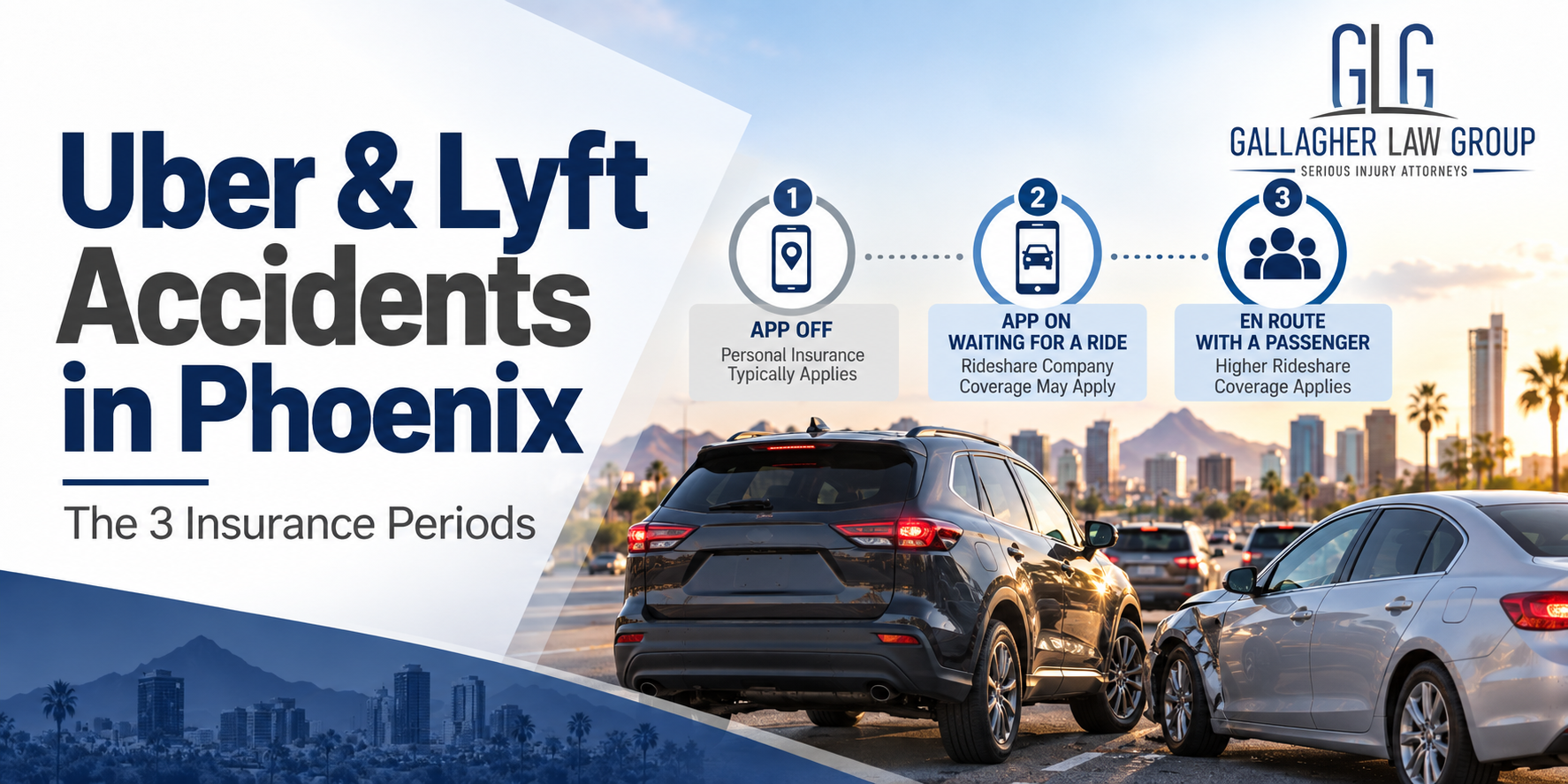
A rideshare crash is not an ordinary car accident claim. Which insurance policy applies depends entirely on what the driver was doing at the moment of impact, and the difference between periods can be the difference between minimal coverage and a policy adequate for a catastrophic injury.
Phoenix has heavy rideshare volume, driven by the airport, the entertainment districts, and the events calendar. These crashes are common, and the coverage analysis is where they are won or lost.
The Three Periods
Period one: app off
The driver is not working. Only their personal auto policy applies, and rideshare coverage generally doesn’t apply.
Personal policies often exclude commercial use, which means this can become contested if the driver had just logged off.
Period two: app on, waiting for a request
The driver is logged in and available but has not accepted a trip. Contingent liability coverage typically applies at limits well below the active period, and frequently only where the driver’s own insurance does not respond.
Period three: request accepted, en route, or carrying a passenger
This is where substantial coverage attaches. The major platforms carry commercial liability coverage at limits far above the state minimum during the active period, along with uninsured and underinsured coverage.
The gap between period two and period three is enormous. Establishing which applies is therefore the central question.
Why the Period Matters So Much
The practical gap between the coverage periods is worth stating in concrete terms.
During the active period, the major platforms carry commercial liability coverage at limits many times the Arizona state minimum, along with uninsured and underinsured coverage at substantial limits.
During the waiting period, contingent coverage is a small fraction of that amount, and it typically applies only when the driver’s own policy does not respond first.
For a serious injury, that difference determines whether the claim can be resolved adequately or whether the injured person is left pursuing a driver personally for an amount they will never pay.
The Evidence Sits With the Platform
The company holds app status data, GPS records, trip timestamps, and driver activity logs. None of it is available without a request, and platforms do not offer it voluntarily.
A preservation letter sent promptly by GLG is what secures it. Once litigation is anticipated, the obligation to preserve attaches, and a letter identifying the specific categories converts routine deletion into a spoliation issue.
Other evidence supports the same conclusion. A phone mounted with the app visible, a passenger in the vehicle, statements the driver made at the scene, and the presence of a trade dress placard all help establish status.
Airport and Event Volume
Phoenix Sky Harbor generates enormous rideshare volume, and the airport channels that traffic through designated pickup areas with their own circulation patterns.
Crashes in those areas involve congestion, drivers watching for passengers rather than traffic, pedestrians moving between vehicles while carrying luggage, and shuttle and commercial traffic sharing the same space.
Major event venues across the metro create the same conditions periodically, with heavy pedestrian traffic and drivers unfamiliar with the area following navigation.
Camera coverage in these locations is generally good, which is an advantage — provided footage is requested before it cycles out.
Who Can Claim
- Passengers injured while riding
- Drivers of other vehicles struck by a rideshare driver
- Pedestrians and cyclists hit during a pickup, drop-off, or sudden maneuver
- Rideshare drivers injured by another motorist
- Passengers injured by a third party while riding
Passengers are generally in the strongest position because the active period applies clearly to them, and their own conduct rarely contributes to the crash.
Rideshare drivers injured by someone else are often unaware that the platform’s uninsured and underinsured coverage may apply during the active period, which can matter enormously when the at-fault driver carries minimum coverage.
Multiple Passengers and Limits
When several people are injured in a single rideshare crash, the available coverage is divided among them.
Policies typically carry a per-person limit and a total per-accident limit, and a crash injuring a driver, two passengers, and an occupant of another vehicle can exhaust the total, with each receiving a fraction of their claim.
This is precisely where each injured person’s uninsured and underinsured coverage matters, which is why every claimant should review their own policies rather than assuming the platform’s coverage will resolve everything.
Pickup and Drop-Off Crashes
A distinct category of Phoenix rideshare collisions involves the pickup itself rather than ordinary driving.
Drivers stop abruptly when they spot a passenger, pull to the curb across traffic, stop in travel lanes, and make sudden turns when navigation redirects them. Passengers open doors into traffic and cyclists.
Around the airport, the entertainment districts, and event venues, these maneuvers occur in dense traffic with pedestrians present, and the resulting collisions frequently involve people who were not in either vehicle.
Food Delivery Works the Same Way
The same three-period structure applies to food and grocery delivery platforms operating across the Phoenix area.
Coverage escalates once an order is accepted, and the same status question arises. Delivery drivers also generate a distinct crash pattern — sudden stops near addresses, unexpected reversals, and parking maneuvers in residential streets and apartment complexes.
Drivers frequently carry personal policies that exclude delivery activity entirely, which means the platform’s coverage may be the only source available where the driver was active. There may be almost nothing where they were not.
The Independent Contractor Argument
Platforms classify drivers as independent contractors and use that classification to avoid responsibility for drivers’ conduct beyond providing insurance.
In some circumstances, a platform may bear responsibility more directly— for negligently selecting or retaining a driver with a disqualifying record, or for a system that created pressure to drive unsafely.
Those arguments are more involved than a straightforward claim under the applicable policy, and they matter most when injuries are severe and available coverage remains insufficient.
Passengers Face Fewer Obstacles
A passenger injured in a rideshare vehicle is generally in the strongest position of anyone involved.
Their own conduct rarely contributed; the active period coverage applies clearly; and, where the other driver was at fault, the platform’s uninsured and underinsured coverage may respond in addition to that driver’s liability policy.
Passengers should still document the trip. A screenshot showing the driver, vehicle, route, and timestamps is the clearest possible proof of status and takes only seconds to capture.
Deadlines and Preservation
Arizona generally allows two years from the date of injury to file suit, and claims involving governmental entities face much shorter notice requirements.
The more pressing timeline is evidentiary. Platform records, dashcam footage, and business surveillance all operate on retention cycles measured in weeks, and the data establishing which coverage period applied is the single most valuable thing in the case.
A preservation letter sent in the first days is what protects it, and it cannot be sent by someone who has not yet been retained.
At the Scene
- Photograph the vehicle, including any rideshare placard or decal
- Note whether a passenger was present and get their contact details
- Ask the driver directly whether they were on a trip, and note the answer
- Screenshot your own ride in the app if you were the passenger
- Photograph vehicle positions, damage, and the roadway before anything moves
- Note the exact time, since platform records are timestamped
- Seek medical attention promptly
Ask the driver whether they were on a trip at the scene. Drivers usually answer honestly in the moment, and that answer, recorded in a report or heard by a witness, is useful when the status is later disputed.
Passengers should also know that a claim arising from a rideshare crash is made against insurance, not the driver personally. People hesitate because they like the driver or do not want to cause trouble, and that hesitation costs them a claim the coverage exists to pay.
If you were injured in a rideshare crash in Phoenix, call GLG quickly. The TA company holds the data that determines which policy applies, with no obligation to keep it for you.