


Losing a limb changes almost every part of daily life. Medical care, work, independence, and mental health are all affected at once. At GLG Personal Injury, we work with amputation clients across Phoenix and the surrounding Arizona communities, and we know families often have one urgent question early on. They want to know what their claim is actually worth.
This guide explains how amputation injury claims are valued in Arizona, what categories of damages apply, and which factors tend to raise or lower a settlement. If you or a loved one needs help or more information, contact our Phoenix injury lawyers today.
| Amputation injury claims in Arizona are valued using two categories of damages. Economic damages cover medical bills, prosthetics, and lost income. Non-economic damages cover pain, disfigurement, and loss of enjoyment of life. Arizona follows a pure comparative negligence rule, so an injured person can recover damages even if they share most of the fault, though the award is reduced by their percentage of fault. Settlement value depends on the level of amputation, the person’s occupation, their age, and the strength of liability evidence. |
What Makes Amputation Injury Claims Unique
Amputation cases are treated differently than many other personal injury claims because the loss is permanent and visible. There is no full recovery to point to, so the value of the claim has to account for a lifetime of adjustment rather than a period of healing.
Insurance companies know this too, which is why amputation claims often draw more scrutiny and slower negotiation than a typical soft tissue injury claim.
Economic Damages in Amputation Claims
Economic damages are the financial losses that can be documented with bills, receipts, and wage records. In an amputation case, these tend to be significant and long-term.
Medical Expenses
- Emergency treatment and surgery at the time of the amputation
- Hospitalization and inpatient recovery care
- Follow-up procedures and revision surgeries
- Physical therapy and occupational therapy
- Future medical treatment tied to the amputation site
Prosthetic Devices and Ongoing Care
A prosthetic limb is rarely a one-time purchase. A claim should account for the full projected cost of prosthetics over the person’s expected lifetime, not just the first device.
- Initial prosthetic device and fitting
- Replacement devices, typically every three to five years
- Adjustments as the residual limb changes over time
- Ongoing maintenance, repairs, and specialty components
Lost Wages and Loss of Earning Capacity
This covers income lost while recovering, as well as any long-term reduction in earning capacity if the person can no longer perform their prior job.
- Wages lost during hospitalization and recovery
- Reduced capacity to return to a physically demanding job
- Cost of retraining or vocational transition
- Long-term reduction in career earning potential
Non-Economic Damages in Amputation Claims
Non-economic damages compensate for losses that do not come with a receipt. They are harder to calculate, but in amputation cases they are often just as significant as the economic losses.
- Pain and suffering, including ongoing conditions such as phantom limb pain
- Loss of enjoyment of life, covering hobbies and routines the person can no longer do the way they once did
- Disfigurement and scarring, compensated separately from pain and suffering in many valuations
- Mental and emotional trauma, including depression, anxiety, and post-traumatic stress
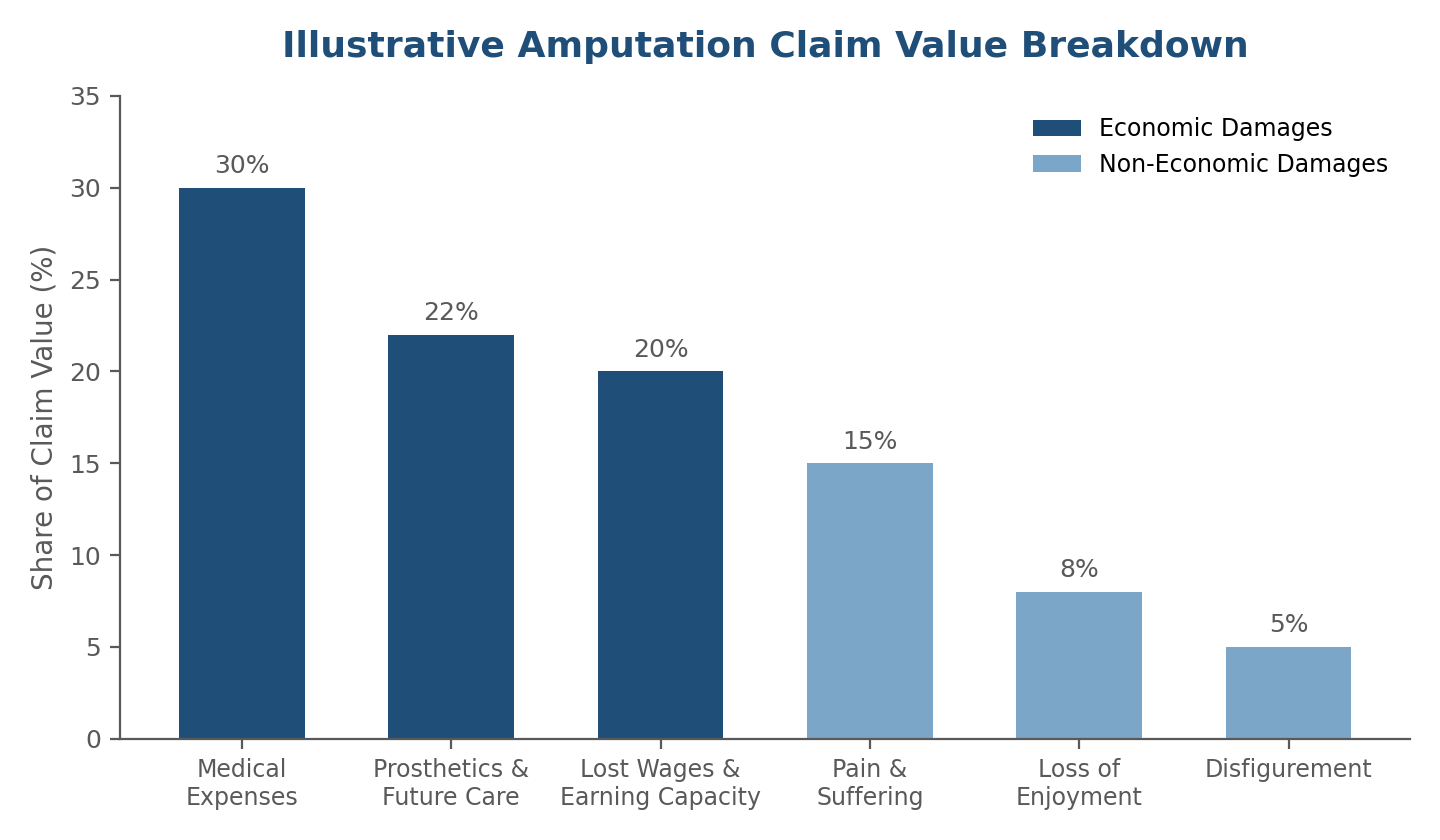
Illustrative example only. Actual damages allocation varies by case and is not a guarantee of outcome.
How Arizona Comparative Negligence Affects Amputation Claims
Arizona follows a pure comparative negligence rule. This means an injured person can still recover damages even if they were partly responsible for the accident, including situations where they were more than fifty percent at fault.
The catch is that the final award is reduced by the injured person’s percentage of fault. For example, if a jury finds a claim worth $400,000 but decides the injured person was 20% at fault, the award is reduced to $320,000.
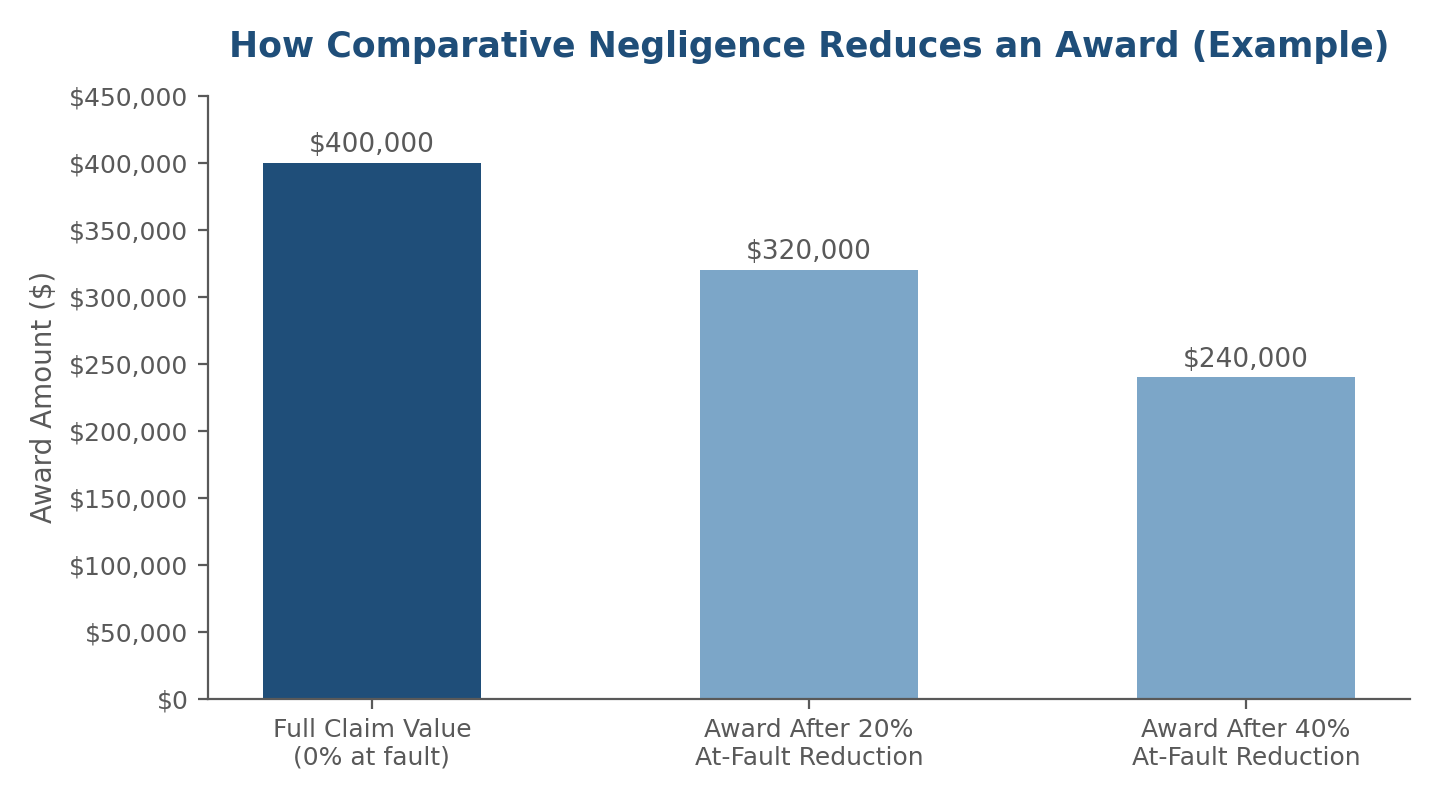
Illustrative example only. Actual awards depend on the facts of each case.
Because of this rule, the way fault is argued and documented has a direct effect on the final value of an amputation claim, sometimes a larger effect than the medical evidence itself.
Common Causes of Amputation Injuries in Arizona
- Motor vehicle and motorcycle collisions
- Workplace accidents involving heavy machinery or industrial equipment
- Construction site incidents
- Defective products or power tools
- Severe burns or crush injuries
- Medical malpractice, including delayed diagnosis of infection or vascular conditions
The cause of the amputation matters because it determines who can be held liable and which insurance policies or coverage limits apply to the claim.
Factors That Influence the Value of an Amputation Claim
- Level of amputation, since above-the-joint amputations generally carry higher value than below-the-joint amputations
- Whether the affected limb was dominant, particularly for arm and hand amputations
- The injured person’s age and life expectancy
- Occupation and physical demands of the prior job
- Strength of the liability evidence against the at-fault party
- Available insurance coverage and policy limits
- Quality and consistency of medical documentation
No two amputation claims are valued the same way, since the combination of these factors is different for every case.
The Role of Expert Testimony in Valuing Amputation Claims
Because amputation claims involve long-term projections, expert testimony plays a central role in supporting the requested value.
- Life care planners estimate future medical treatment and prosthetic replacement costs
- Vocational experts assess whether the person can return to their prior occupation
- Economists translate these projections into present-day dollar figures
Claims that include this kind of expert analysis tend to settle for significantly more than claims that rely on medical bills alone.
Arizona Statute of Limitations for Amputation Injury Claims
In Arizona, injured people generally have two years from the date of the injury to file a personal injury lawsuit. Claims against a government entity have a much shorter notice requirement, often within one hundred eighty days. Missing these deadlines can prevent an injured person from recovering compensation at all, regardless of how strong the claim is.
Why Work With GLG Personal Injury Lawyers
At GLG Personal Injury, we build amputation claims around the full scope of the loss, not just the initial hospital bill. We work with life care planners, vocational experts, and treating physicians to document the true long-term cost of the injury. Then we negotiate from that position, rather than accepting an early settlement offer based only on visible medical expenses.
If you or a family member has suffered an amputation injury in Phoenix or elsewhere in Arizona, we are ready to review your case and explain what it may be worth.
Frequently Asked Questions
How much is an amputation injury claim worth in Arizona?
There is no fixed number. Value depends on the level of amputation, age, occupation, future medical needs, and the strength of the liability evidence. A qualified attorney can provide a realistic range after reviewing medical records and the facts of the accident.
Can I still recover damages if I was partly at fault for my accident?
Yes. Arizona pure comparative negligence rule allows recovery even if you were mostly at fault, though your award is reduced by your percentage of fault.
How long do I have to file an amputation injury claim in Arizona?
Generally two years from the date of the injury for most personal injury claims. Claims against a government entity require notice much sooner, often within one hundred eighty days.
Does a below the knee amputation settle for less than an above the knee amputation?
Often, yes, because above the joint amputations typically involve greater loss of function and higher lifetime prosthetic and care costs. Every case still depends on the individual circumstances.