

The Growing Impact of Speeding on Arizona Roads
Speeding is one of the most significant contributing factors in serious and fatal car accidents across Arizona. In rapidly expanding metro areas like Phoenix, where major highways, heavy traffic, and long commuting distances are common, excessive speed increases both the likelihood and severity of collisions.
From a legal perspective, speeding is not just a traffic violation; it is often a key factor in establishing negligence in personal injury accidents and wrongful death claims. At GLG Personal Injury Lawyers, we have seen firsthand how speeding-related crashes can permanently alter lives, leaving victims with severe injuries, financial burdens, and long-term emotional trauma.
Understanding the risks, legal consequences, and victims’ rights is essential for anyone affected by a high-speed collision in Arizona.
Speeding Statistics in Arizona
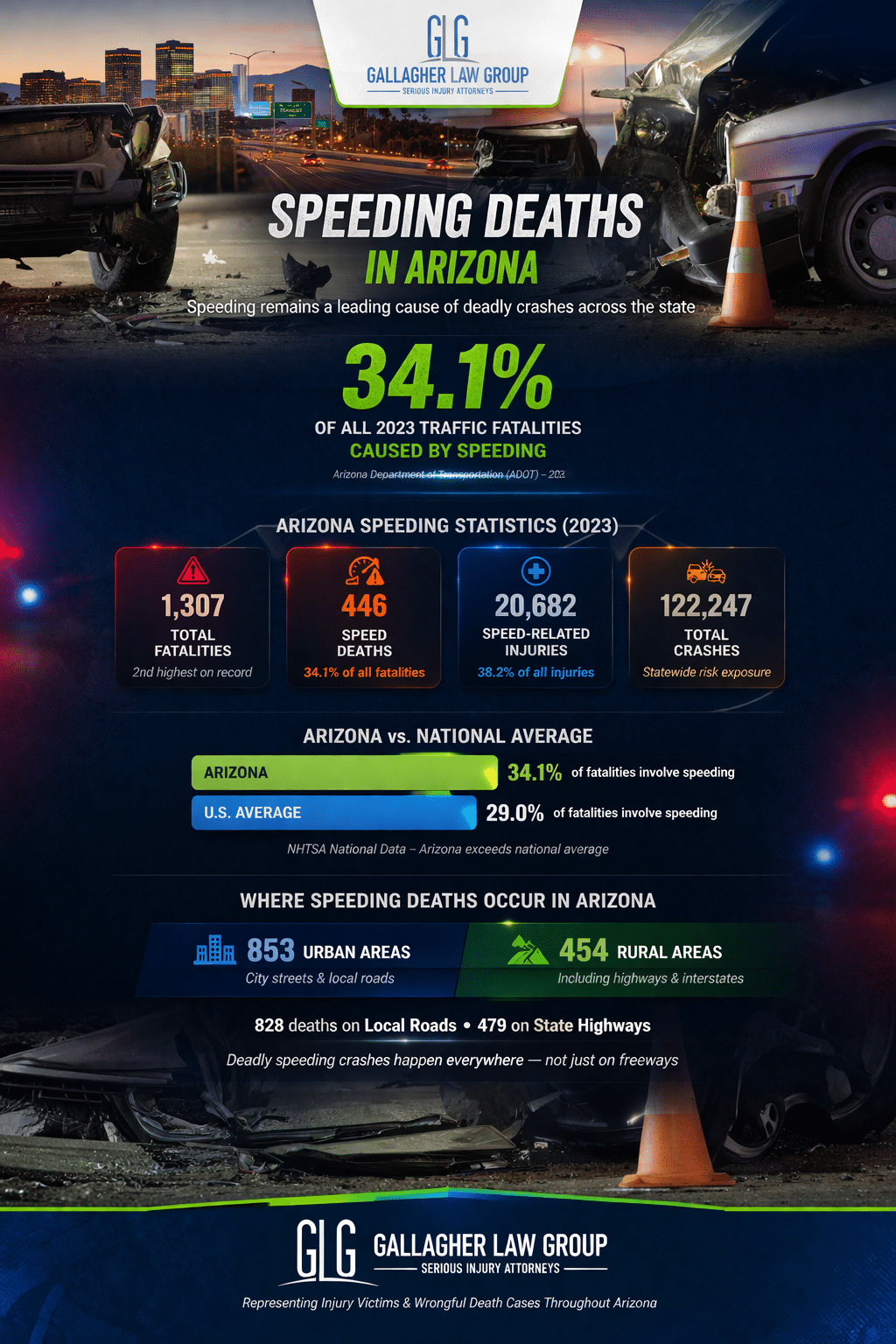
Speeding continues to be a leading cause of traffic-related fatalities throughout the state. Arizona recorded 1,307 traffic fatalities in 2023, making it the second-highest annual total ever reported. Data from the Arizona Department of Transportation (ADOT) highlights just how significant a role speed plays in serious crashes.
Key statistics include:
- 1,307 total traffic fatalities in Arizona in 2023
- 446 deaths linked to speeding, accounting for 34.1% of all fatalities
- 20,682 injuries caused by speed-related crashes
- 38.2% of all crash injuries involved speeding
- 122,247 total crashes statewide, showing the overall scale of risk
These numbers are especially concerning when compared to national trends. According to NHTSA data:
- 29% of all U.S. traffic fatalities involve speeding
- Arizona’s 34.1% rate exceeds the national average, indicating a more severe local problem
Crash data also shows where these fatalities happen:
- 853 fatalities occurred in urban areas, compared to 454 in rural areas
- 828 deaths happened on local roads, compared to 479 on state highways
These figures challenge the common belief that high-speed fatal crashes are limited to freeways. In reality, a large number of deadly speeding accidents occur on city streets throughout Phoenix and other urban areas.
Taken together, the data makes it clear that speeding is not a minor factor in Arizona traffic safety. It is one of the primary reasons crashes become fatal and remains a central issue in personal injury and wrongful death cases.
Why Speeding Leads to More Fatal Crashes
The dangers of speeding are rooted in both physics and human limitations. As speed increases, so does the force involved in a collision, making injuries far more severe.
From an accident reconstruction and legal standpoint, speeding affects crashes in several key ways:
- Reduced reaction time: Drivers have less time to respond to hazards
- Increased stopping distance: Vehicles require significantly more space to come to a complete stop
- Greater impact force: Higher speeds result in more severe damage and injuries
- Loss of control: Vehicles are harder to maneuver safely at high speeds
Even small speed increases can drastically change the outcome of a crash. For example, a collision at 40 mph is far more survivable than one at 70 mph, where the likelihood of fatal injury rises sharply.
Teens and Speeding in Arizona
Teen drivers are disproportionately involved in speeding-related crashes, and the data clearly shows why this remains a serious safety concern. Younger drivers face higher risks due to inexperience, decision-making factors, and a greater likelihood of engaging in dangerous driving behaviors.
Key statistics include:
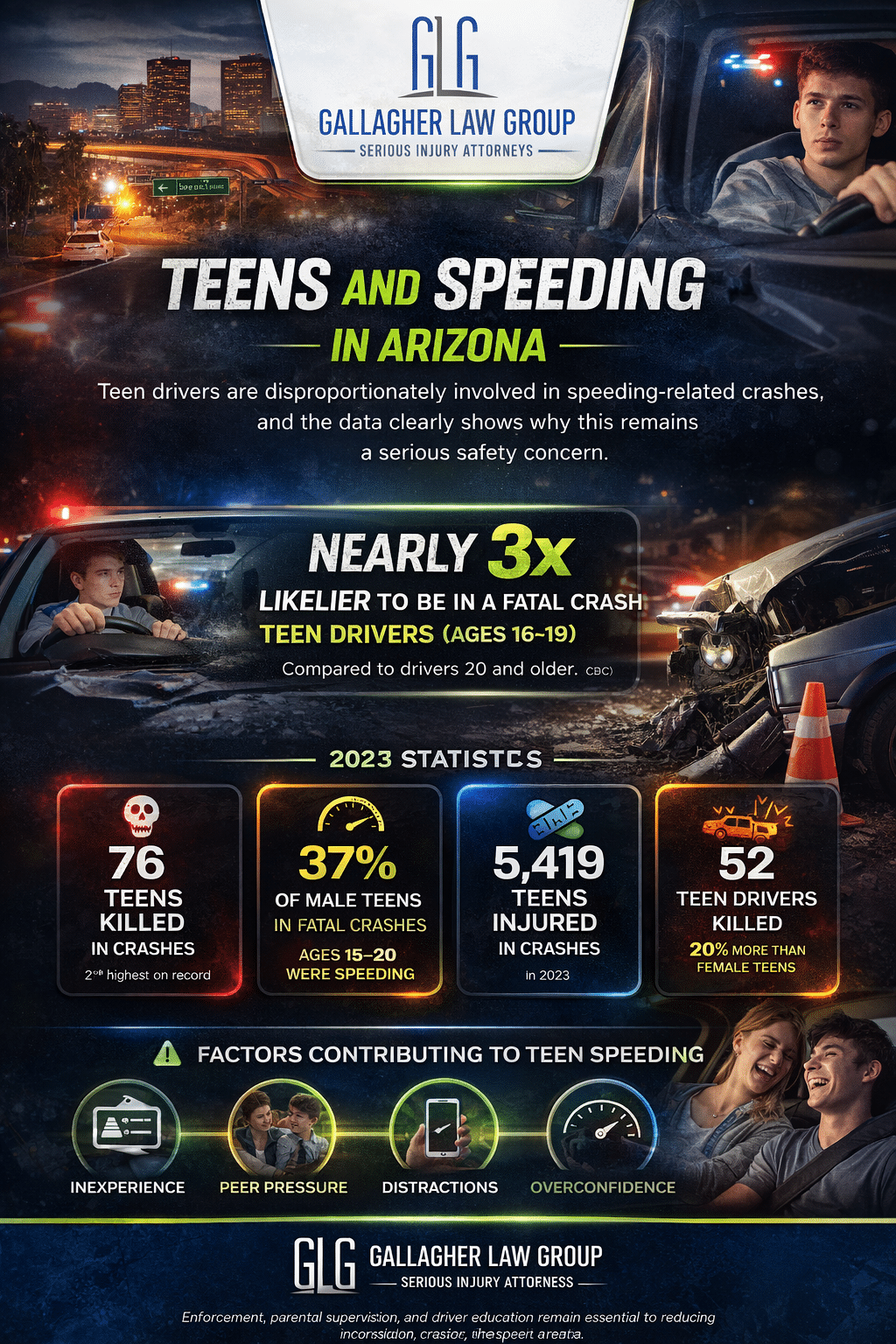
- Teen drivers ages 16–19 are nearly 3 times more likely to be involved in a fatal crash compared to drivers age 20 and older (CDC)
- Motor vehicle crashes are a leading cause of death for teenagers in the United States (CDC)
- In 2023, 37% of male teen drivers (ages 15–20) involved in fatal crashes were speeding
- In the same age group, 19% of female teen drivers in fatal crashes were speeding (NHTSA)
- 76 individuals ages 15–19 were killed in crashes in Arizona in 2023
- 5,419 individuals ages 15–19 were injured in Arizona crashes
- 52 teen drivers were killed in Arizona in 2023
- 3,258 teen drivers were injured in crashes statewide (ADOT Crash Facts)
These figures show that speeding is not just a contributing factor; it is one of the primary reasons crashes involving teen drivers become fatal or severe.
Several factors contribute to teen speeding, including lack of driving experience, peer pressure, overconfidence, and distractions from passengers or mobile devices. Arizona’s Graduated Driver Licensing (GDL) system is designed to reduce these risks by limiting nighttime driving and restricting passenger use during the early stages of driving. However, the data demonstrates that enforcement, parental supervision, and driver education remain essential to reducing teen-related crashes.
From a legal standpoint, accidents involving teen drivers can raise complex liability issues, particularly when parents or guardians may share responsibility depending on the circumstances.
Arizona Laws on Speeding
Arizona enforces strict laws to regulate speed and promote roadway safety. Under A.R.S. § 28-701, drivers are required to operate their vehicles at a speed that is reasonable and prudent based on current conditions, regardless of posted limits.
Important aspects of Arizona speeding laws include:
- Absolute speed limits that vary depending on the type of roadway
- Criminal speeding charges, which may apply when:
- Driving more than 20 mph over the posted limit
- Exceeding 85 mph on any roadway
- Penalties, including:
- Fines and court fees
- Points on a driver’s license
- Potential jail time
- License suspension for repeat offenses
In personal injury cases, a violation of these laws can serve as strong evidence of negligence. When a driver exceeds safe speeds and causes a crash, it significantly strengthens the injured party’s claim for compensation.
Injuries Caused by Speeding Accidents
High-speed collisions frequently result in severe and life-altering injuries. The force involved in these crashes often exceeds what the human body can withstand. No matter whether the vehicle is a truck, car, or motorcycle, higher speeds increase the risk of catastrophic injury.
Common injuries include:
- Traumatic brain injuries (TBI)
- Spinal cord injuries and paralysis
- Broken bones and complex fractures
- Internal bleeding and organ damage
- Severe burns and deep lacerations
Many victims face long-term consequences such as permanent disability, chronic pain, and psychological trauma. These injuries often require extensive medical treatment, rehabilitation, and ongoing care, creating both physical and financial challenges.
Victims of Speeding Accidents
Speeding accidents impact on a wide range of individuals, not just the drivers involved. Victims may include:
- Passengers in vehicles
- Pedestrians crossing or walking along roadways
- Cyclists sharing traffic lanes
- Motorcyclists, who face significantly higher injury risks
The ripple effects of speeding accidents extend beyond immediate victims. Families often experience emotional distress, financial hardship, and long-term instability following a serious or fatal crash.
Wrongful Death and Legal Rights in Arizona
When speeding results in a fatal accident, surviving family members may pursue a wrongful death claim under Arizona law. These claims are designed to provide financial relief and accountability when a loved one’s death was caused by negligence.
Eligible parties typically include:
- Spouses
- Children
- Parents
- Personal representatives of the estate
Compensation in wrongful death cases may cover: - Funeral and burial expenses
- Loss of income and financial support
- Loss of companionship and guidance
- Emotional suffering endured by surviving family members
Establishing that speeding contributed to the accident is often central to these claims. Evidence such as police reports, expert analysis, and crash data can play a critical role in proving liability.
Frequently Asked Questions
-
How common are speeding-related deaths in Arizona?
Speeding is a factor in roughly one-third of all traffic fatalities in Arizona. Recent data shows that over 400 deaths annually are linked to excessive speed or driving too fast for conditions, making it one of the leading causes of fatal crashes in the state.
-
What is considered to be criminal speeding in Arizona?
In Arizona, criminal speeding occurs when a driver exceeds the speed limit by more than 20 mph, drives over 85 mph regardless of the limit, or speeds in certain restricted zones. Criminal speeding can result in fines, points on your license, and even jail time.
-
Can speeding be used to prove fault in a car accident?
Yes. Speeding is a strong indicator of negligence in personal injury cases. If a driver was speeding at the time of a crash, it can significantly strengthen the injured party’s claim and help establish liability.
-
Who can file a wrongful death claim after a speeding accident in Arizona?
Arizona law allows certain family members—such as spouses, children, and parents—to file a wrongful death claim. In some cases, a personal representative of the deceased’s estate may also bring the claim.
-
What types of injuries are most common in speeding accidents?
Speeding accidents often result in severe injuries, including traumatic brain injuries, spinal cord damage, broken bones, internal bleeding, and burns. These injuries are more serious due to the high-impact forces involved.
-
Why are teen drivers more likely to be involved in speeding crashes?
Teen drivers are more prone to speeding due to inexperience, peer pressure, and risk-taking behavior. Statistics show that teen drivers have a much higher fatal crash rate compared to older drivers, with speeding being a major contributing factor.
-
Can I still get compensation if I was partially at fault?
Yes. Arizona follows a pure comparative negligence rule, which means you can still recover compensation even if you are partially at fault. However, your total recovery will be reduced by your percentage of faults.
-
What evidence is used to prove speeding in an accident case?
Evidence may include police reports, traffic camera footage, eyewitness statements, vehicle black box data, and accident reconstruction analysis. This evidence helps establish how fast the driver was going and whether that speed contributed to the crash.
-
When should I contact a personal injury lawyer after a speeding accident?
It is best to contact a personal injury lawyer as soon as possible after an accident. Early legal guidance helps preserve evidence, protect your rights, and improve your chances of securing full compensation.
How Speeding Impacts Personal Injury Claims
Speeding is one of the clearest indicators of negligence in a motor vehicle accident case. When a driver violates traffic laws, it creates a strong foundation for a personal injury claim.
Key types of evidence used to prove speeding include:
- Police accident reports and citations
- Traffic camera or surveillance footage
- Eyewitness testimony
- Vehicle data recorders (black box data)
- Accident reconstruction expert analysis
Arizona follows a pure comparative negligence rule, meaning injured parties can still recover compensation even if they share some degree of fault. However, the total recovery is reduced by the assigned percentage of fault.
Insurance companies often attempt to minimize payouts by disputing liability or downplaying injuries. An experienced legal team can counter these tactics with evidence-based arguments and strategic negotiation.
Preventing Speeding-Related Deaths
Reducing speeding-related fatalities requires a combination of enforcement, education, and individual responsibility. While law enforcement agencies in Phoenix actively monitor and enforce speed limits, driver behavior remains the most important factor.
Practical steps to reduce risk include:
- Following posted speed limits at all times
- Adjusting speed for weather, traffic, and road conditions
- Avoiding aggressive or reckless driving
- Staying focused and eliminating distractions
Safe driving decisions not only protect the driver but also everyone else on the road.
How GLG Personal Injury Lawyers Supports Victims
Speeding accidents often involve complex legal and factual issues that require a thorough and strategic approach. GLG Personal Injury Lawyers represents individuals and families throughout Phoenix who serious car accidents and wrongful death cases have impacted.
Our firm focuses on:
- Conducting detailed accident investigations
- Preserving and analyzing critical evidence
- Working with medical and accident reconstruction experts
- Handling all communication with insurance companies
- Pursuing full and fair compensation for our clients
With extensive experience in Arizona personal injury law, our team understands how to build strong cases and advocate effectively for those affected by negligent drivers. We are committed to protecting our clients’ rights and helping them move forward after life-changing events.
Protecting Your Rights After a Speeding Accident
The consequences of speeding extending far beyond traffic tickets can result in devastating injuries, permanent disability, and loss of life. For victims and their families, understanding their legal rights is a critical step toward recovery.
Taking prompt action after an accident can make a significant difference in the outcome of a claim. Preserving evidence, seeking medical care, and speaking with an experienced attorney can help ensure that your rights are protected from the very beginning.
GLG Personal Injury Lawyers is dedicated to helping victims of speeding accidents pursue justice, accountability, and the compensation they deserve.
References
Arizona Department of Transportation, 2023 Arizona Crash Facts. (Arizona Department of Transportation)
Arizona Department of Transportation, Traffic fatalities in Arizona dip slightly in 2023. (GovDelivery)
Centers for Disease Control and Prevention, Teen Drivers. (CDC)
NHTSA / Traffic Safety Marketing, Speeding facts and statistics. (Traffic Safety Marketing)